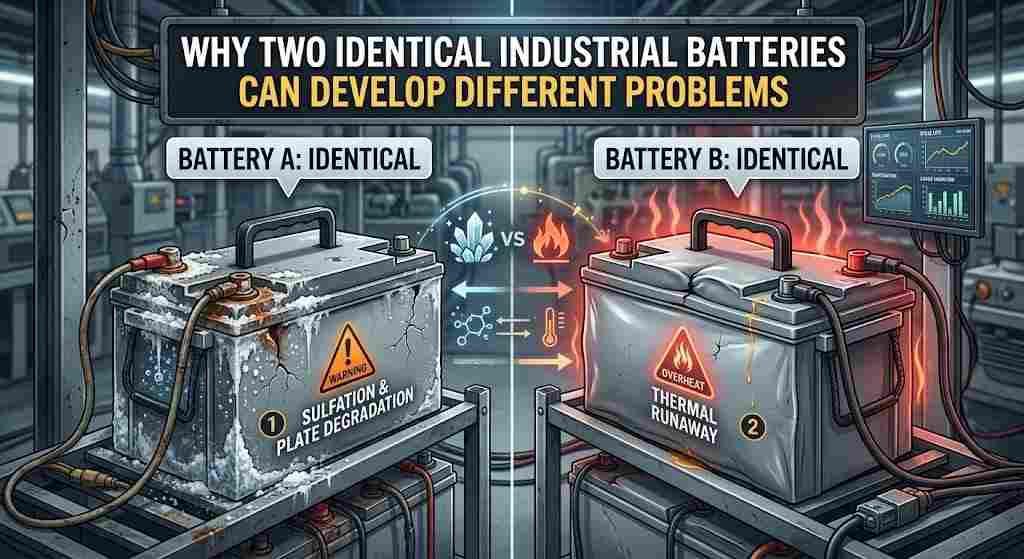
Have you ever noticed two industrial batteries of the same brand, model, age, and capacity performing completely differently? One battery may continue powering equipment throughout a busy shift, while the other struggles to hold a charge, overheats during operation, or requires frequent maintenance. At first glance, this difference can seem confusing. After all, if both batteries are identical, shouldn’t they perform the same way?
The reality is that an industrial battery’s performance depends on much more than its specifications. Everyday usage, charging routines, environmental conditions, maintenance quality, and even small manufacturing variations can influence how a battery ages. When problems appear, timely Industrial battery repair can help identify the underlying cause, prevent further damage, and determine whether the battery can be restored to reliable operation.
Understanding why similar batteries develop different problems helps businesses make better maintenance decisions, reduce unexpected downtime, and get more value from their equipment. Let’s explore the main reasons these differences occur and what you can do to prevent avoidable battery failures.
1. Different Charging Habits Lead to Different Results
Charging practices are among the most important factors affecting industrial battery performance. Even when two batteries are used in the same facility, their charging histories may be very different.
One battery might be charged according to the manufacturer’s recommendations, while another may regularly be charged at the wrong time, disconnected too early, or left partially discharged for extended periods.
Incomplete charging
Many industrial batteries need an appropriate charging cycle to reach their intended state of charge. When a battery is repeatedly returned to service before charging is complete, its available capacity may gradually decline.
The effects depend on the battery chemistry. For example, repeated undercharging can contribute to sulfation in lead-acid batteries, reducing their ability to accept and deliver energy efficiently.
Overcharging and excessive heat
Overcharging can create unnecessary heat and accelerate battery deterioration. In flooded lead-acid batteries, excessive charging may increase water loss. In other battery types, improper charging can place stress on the cells or trigger protective shutdowns.
Two batteries connected to different chargers, or operated with different charging schedules, may therefore develop different symptoms even if they started with similar performance.
What businesses can do: Use compatible chargers, follow the recommended charging procedure, and review charging records when one battery begins performing worse than another.
2. Operating Conditions Are Rarely Exactly the Same
Two batteries may power identical machines, but that does not mean they experience identical workloads.
In a warehouse, one forklift might spend most of its shift transporting light loads across short distances. Another might repeatedly lift heavy pallets, travel longer distances, and operate almost continuously.
These differences affect energy consumption, temperature, and the frequency of charging cycles.
Heavy workloads increase battery stress
A battery regularly exposed to high power demands may experience greater electrical and thermal stress than one used under lighter conditions. Depending on the battery design and application, repeated heavy loads can accelerate wear or make existing weaknesses more noticeable.
For instance, two forklift batteries may appear equally healthy during light-duty operation. However, when both are assigned to demanding shifts, the battery with less remaining capacity may struggle to maintain the required voltage.
Different duty cycles affect lifespan
A duty cycle describes how a battery is used, discharged, and recharged over time. One battery may experience frequent partial discharges, while another completes longer operating periods before charging.
The impact varies by chemistry and operating conditions. Some batteries are designed to tolerate particular cycling patterns better than others.
Practical tip: Track operating hours, workload, discharge levels, and charging frequency for individual batteries. These records can reveal whether one battery is experiencing more demanding conditions than its counterpart.
3. Temperature Differences Can Cause Uneven Battery Aging
Temperature has a significant influence on battery performance. Excessive heat can accelerate chemical aging, while cold conditions can temporarily reduce available capacity and power.
Even batteries operating in the same building may experience different temperatures.
One battery might be installed in equipment that operates near a warm production area. Another may spend more time in a cooler storage section. Differences in ventilation, charger placement, and equipment design can also influence operating temperatures.
Why heat creates long-term problems
High temperatures can accelerate internal degradation and shorten battery life. In lead-acid batteries, excessive heat may increase water consumption and corrosion. Lithium-ion batteries can also age more rapidly when regularly exposed to temperatures outside their recommended range.
A battery that repeatedly operates at elevated temperatures may develop reduced capacity or increased internal resistance sooner than another battery of the same model.
Cold conditions affect available power
Cold temperatures can reduce the amount of energy a battery can deliver at a given moment. This may cause slower equipment operation, reduced runtime, or voltage-related performance issues.
These effects are not always permanent. A battery that performs poorly in cold conditions may recover some of its normal performance when it returns to a suitable operating temperature. However, repeated exposure to unsuitable conditions can still contribute to long-term problems.
What to do: Keep batteries within the manufacturer’s recommended temperature range, maintain proper ventilation, and investigate unusual heat rather than assuming it is normal.
4. Small Manufacturing Differences Can Affect Performance
Identical product models are manufactured to meet established specifications, but individual batteries are not necessarily perfectly identical internally.
Manufacturing processes involve materials, cell assembly, electrical connections, and quality-control measurements. Small differences can remain within acceptable production tolerances while still influencing how individual units perform over time.
For example, two batteries may begin with slightly different internal resistance or usable capacity. These differences might be too small to notice during routine operation.
However, as the batteries age, the difference may become more noticeable.
Weak cells can affect the entire battery
In a battery made up of multiple cells, one weaker cell can limit the performance of the complete unit. If a cell loses capacity more quickly than the others, the battery may struggle to deliver its expected runtime.
In a lead-acid battery, cell imbalance can affect charging behavior and available capacity. In a lithium-ion battery pack, differences between cells may lead the battery management system to limit charging or discharging to protect the pack.
This explains why a battery can experience significant problems even when its exterior looks identical to another battery that works properly.
Practical tip: When comparing two batteries, look beyond their labels and physical appearance. A qualified technician can evaluate voltage, capacity, internal resistance where appropriate, and individual cell or module performance using methods suitable for the battery type.
5. Maintenance Quality Makes a Major Difference
Maintenance is another reason two similar batteries can develop different problems.
One battery may receive regular inspections, while another is only checked when its performance noticeably declines. Over time, neglected maintenance can allow small issues to become larger failures.
The correct maintenance requirements depend on battery chemistry. Flooded lead-acid batteries, for example, may require electrolyte-level checks and watering according to manufacturer guidance. Sealed lead-acid batteries and lithium-ion batteries have different requirements and should not be maintained as though they were identical internally.
Dirty or corroded connections
Loose, damaged, or corroded connections can increase electrical resistance. This may cause voltage drops, localized heating, and reduced power delivery.
A battery with clean, secure connections may operate normally while an otherwise identical battery develops performance issues because of a poor connection.
Missed warning signs
Regular inspections can reveal early signs of trouble, including:
- Unusual heating during charging or operation.
- Visible corrosion, damaged cables, or loose connections.
- Unexpected reductions in operating time.
- Changes in charging duration or charging behavior.
- Physical swelling, leakage, or other signs of damage.
Not every symptom indicates the same underlying problem. For example, reduced runtime might result from battery degradation, excessive workload, a charger fault, or an electrical issue elsewhere in the equipment.
What businesses can do: Establish a maintenance schedule based on the battery manufacturer’s instructions. Record inspection findings and investigate recurring problems before they interrupt operations.
6. Different Storage Conditions Can Damage Batteries Unevenly
Industrial batteries do not stop aging when they are removed from equipment. Storage conditions can influence their condition, particularly when batteries remain unused for long periods.
Consider two replacement batteries purchased at the same time. One is stored in a suitable environment and checked periodically. The other remains unused for months without appropriate charge monitoring.
When both batteries are eventually installed, their performance may differ because their storage histories were not the same.
Self-discharge and prolonged inactivity
Batteries gradually lose charge during storage, although the rate depends on their chemistry, temperature, condition, and design.
If a battery remains discharged for too long, it may suffer damage. Lead-acid batteries can develop sulfation, while lithium-ion batteries may be harmed if their voltage falls below the manufacturer’s permitted limits.
Improper storage temperatures
Storing batteries in excessively hot or cold environments can affect their condition. High temperatures may accelerate aging, while freezing can pose particular risks to certain discharged lead-acid batteries.
Practical tip: Follow the manufacturer’s storage and periodic charge-checking recommendations. Keep accurate records of storage dates, condition, and maintenance activities.
7. Charger and Equipment Problems May Be Mistaken for Battery Failure
Sometimes the battery is not the primary source of the problem.
Two identical batteries may appear to behave differently because they are used with different chargers, machines, cables, or electrical systems.
For example, one charger may not complete its charging cycle correctly because of a malfunctioning component or incompatible settings. The battery connected to it may gradually lose usable capacity or repeatedly appear undercharged.
Likewise, equipment with excessive electrical demand may drain a healthy battery faster than expected.
Check the complete power system
Before deciding that a battery needs rebuilding or replacement, technicians should consider the surrounding equipment.
A useful diagnostic process may include:
- Checking the charger for faults and confirming compatibility.
- Inspecting cables, connectors, and electrical contacts.
- Reviewing battery voltage and charging behavior.
- Measuring capacity or conducting an appropriate load test.
- Checking the equipment for abnormal power consumption.
Testing should follow the battery manufacturer’s procedures and be performed by trained personnel using suitable equipment.
This approach helps businesses avoid replacing a battery when the actual issue is a faulty charger, damaged connection, or equipment problem.
8. Battery Age Does Not Always Tell the Full Story
Two batteries installed on the same date can have very different levels of wear.
Calendar age measures how long a battery has existed, but it does not fully describe how much work the battery has performed. Operating hours, cycle count, discharge depth, temperature exposure, and charging practices all contribute to its condition.
A battery used occasionally under suitable conditions may remain useful longer than one that operates through demanding shifts every day.
Why performance history matters
Suppose two warehouse batteries are three years old. One has been used for moderate workloads and maintained consistently. The other has handled heavy loads, experienced frequent deep discharges, and operated in a hot environment.
Although their ages are identical, the second battery may have significantly less remaining capacity.
This is why businesses should evaluate battery condition using actual performance data rather than relying exclusively on purchase dates.
Practical tip: Maintain a separate service history for every battery. Include installation dates, charging records, inspections, repairs, operating hours, and recurring performance issues.
9. How to Prevent Similar Batteries From Developing Different Problems
Although some differences are unavoidable, businesses can reduce preventable failures by managing battery use more consistently.
Standardize charging procedures
Provide clear instructions for operators and make sure chargers are appropriate for the battery chemistry and specifications. Avoid relying on assumptions that all batteries can follow the same charging routine.
Match batteries to suitable workloads
Where possible, distribute demanding tasks fairly and avoid repeatedly assigning the same battery to the most energy-intensive equipment. Make sure the battery’s capacity and discharge characteristics match the application.
Monitor performance over time
Record runtime, charging duration, inspection findings, and any unusual behavior. Comparing these records can help identify gradual deterioration before it becomes a major operational problem.
Train equipment operators
Operators are often the first people to notice changes in battery performance. Teach them to report reduced runtime, unexpected shutdowns, unusual heat, and charging problems promptly.
Schedule professional inspections
Qualified technicians can identify electrical, mechanical, and cell-related problems that may not be obvious during a visual inspection. Professional assessment is especially valuable when a battery repeatedly fails despite following normal operating procedures.
10. When Should You Consider Battery Repair or Rebuilding?
Not every battery with reduced performance needs immediate replacement. Depending on its chemistry, design, age, condition, and the nature of the fault, repair or rebuilding may be worth evaluating.
For example, a problem caused by a damaged external connection may be straightforward to correct. Other faults, such as a failing cell or significant internal degradation, require more detailed testing to determine whether repair is technically appropriate and economically sensible.
However, repair is not always the right option. A battery with severe internal damage, unsafe physical deterioration, or extensive degradation may need replacement.
A qualified technician should assess the battery before recommending a solution. The evaluation should consider the cause of failure, expected remaining service life, repair cost, safety requirements, and the consequences of another unexpected breakdown.
For industrial operations, the goal is not simply to get a battery working again. It is to determine whether the battery can deliver dependable performance at a reasonable cost.
Conclusion
Two identical industrial batteries can develop different problems because their real-world experiences are rarely identical. Charging habits, workloads, temperature exposure, maintenance quality, storage conditions, manufacturing variations, and equipment faults can all influence performance. Even batteries purchased on the same day may age at different rates.
The most effective way to manage these differences is to track each battery individually, follow the manufacturer’s recommendations, investigate unusual symptoms, and address minor issues before they cause expensive downtime. When performance declines, proper testing can help distinguish between a battery fault and a problem elsewhere in the electrical system.
For businesses that need dependable industrial power, early diagnosis and informed maintenance decisions can protect equipment, control operating costs, and extend useful battery life where possible. Battery Rescue LLC can be a resource to consider when evaluating industrial battery service needs and exploring practical options for keeping equipment running reliably. The key is to identify the actual cause of the problem rather than assuming that every battery of the same model will need the same solution.