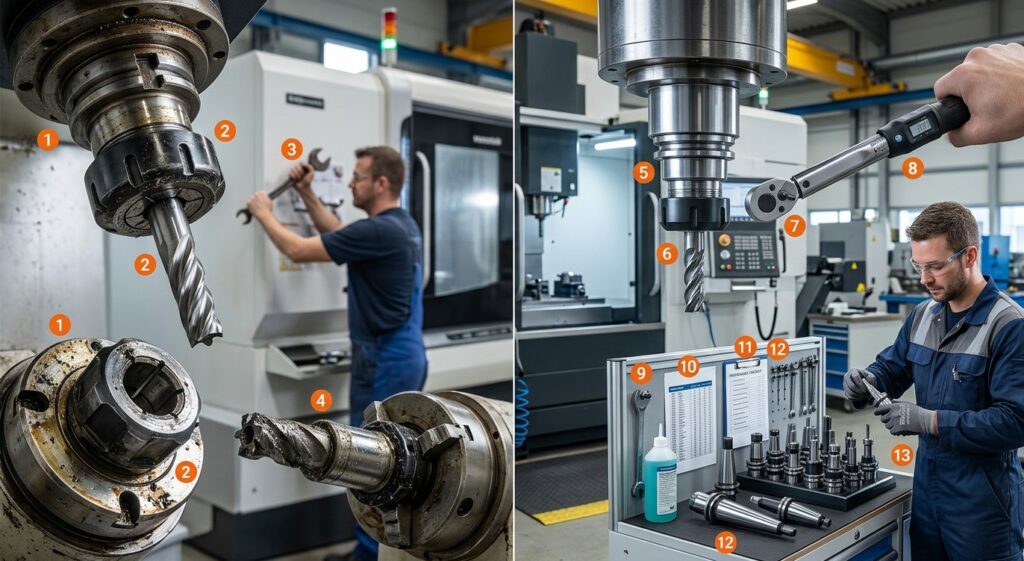
CNC toolholder slippage is a common machining problem that can affect accuracy, cutting tool life, surface finish, and production efficiency. When a cutting tool is not held securely, it may move inside the toolholder during machining or, in some cases, the toolholder itself may not remain properly secured in the machine spindle.
Slippage can result in dimensional errors, broken tools, damaged workpieces, and unexpected machine downtime. Understanding its causes and prevention methods is essential for maintaining reliable CNC operations.
Khokhawala Trading LLC, an Industrial Tools Supplier in Dubai, supports workshops and manufacturers seeking dependable industrial tooling solutions for precision machining and production applications.
This guide explains why CNC toolholder slippage occurs, how to recognize the warning signs, and what practical steps can help prevent it.
Table of Contents
- What Is CNC Toolholder Slippage?
- Common Causes of Toolholder Slippage
- Warning Signs of Tool Slippage
- How Toolholder Slippage Affects Machining
- How to Prevent CNC Toolholder Slippage
- Troubleshooting Toolholder Slippage
- Toolholder Maintenance Checklist
- Frequently Asked Questions
- Conclusion and CTA
1. What Is CNC Toolholder Slippage?
CNC toolholder slippage occurs when a cutting tool moves or rotates inside its holder instead of remaining securely clamped. It can also refer to movement between the toolholder and spindle when the retention system or spindle interface is not functioning correctly.
Two common forms are:
- Tool-to-holder slippage: The cutting tool moves inside a collet, chuck, or shrink-fit holder.
- Holder-to-spindle movement: The toolholder does not remain properly seated or retained in the machine spindle.
Both situations can compromise machining performance and may create safety risks.
2. Common Causes of Toolholder Slippage
2.1 Incorrect Clamping Force
Insufficient clamping force is one of the main reasons a cutting tool may slip. If the holder does not grip the tool firmly enough, cutting forces can overcome the available holding force.
This can happen when a collet nut is not tightened correctly, a clamping mechanism is worn, or the spindle retention system is not operating as intended.
Prevention: Follow the manufacturer’s tightening specifications and use the recommended tools or torque-control method. Avoid guessing the required tightening force.
2.2 Worn or Damaged Collets
Collets grip cutting tools through precision contact surfaces. Over time, repeated use, contamination, incorrect tightening, and excessive loading can cause wear or deformation.
A damaged collet may fail to distribute clamping pressure evenly, increasing the risk of tool movement.
Prevention: Inspect collets regularly for cracks, scoring, deformation, and worn gripping surfaces. Replace components that no longer meet the manufacturer’s requirements.
2.3 Incorrect Tool Shank Diameter
The cutting tool shank must match the holder or collet specification. Using an incorrectly sized shank can prevent proper gripping, even when the assembly appears tight.
Prevention: Verify the cutting tool’s shank diameter and the holder’s compatibility before installation. Never compensate for an incorrect fit by overtightening the nut.
2.4 Excessive Cutting Forces
Heavy cuts, aggressive feed rates, excessive depth of cut, or unsuitable cutting parameters can generate forces beyond the toolholding system’s capabilities.
This may cause the cutting tool to move, pull out, or become damaged.
Prevention: Select appropriate cutting parameters for the workpiece material, tool geometry, holder type, and machine capacity. Increase cutting loads gradually when testing a new setup.
2.5 Dirty or Contaminated Components
Chips, oil, dried coolant, and other contaminants can interfere with the contact between the cutting tool and holder. Contamination on spindle and toolholder tapers can also affect seating and retention.
Prevention: Clean the tool shank, holder bore, collet, nut, and relevant spindle contact surfaces using an appropriate cleaning procedure before assembly.
2.6 Excessive Tool Stick-Out
A cutting tool that extends too far from the holder is more susceptible to bending and vibration. These forces can increase instability and contribute to slippage in an unsuitable or poorly clamped assembly.
Prevention: Use the shortest practical tool projection that allows the cutting tool to reach the machining area safely.
2.7 Incorrect Toolholder Selection
Different toolholders are designed for different tools, machining loads, speeds, and applications. A holder that is unsuitable for the operation may not provide sufficient gripping force or rigidity.
Prevention: Choose a toolholder designed for the cutting tool, spindle interface, machining operation, and expected cutting forces.
2.8 Worn Nuts or Clamping Mechanisms
Damaged collet nuts, worn threads, defective hydraulic mechanisms, or improperly maintained shrink-fit holders can reduce clamping reliability.
Prevention: Inspect all clamping components and follow the maintenance recommendations for the specific toolholding system.
3. Warning Signs of Tool Slippage
Tool slippage may not always be immediately visible. However, several symptoms can indicate that the toolholding assembly needs inspection.
Common warning signs include:
- Unexpected changes in machined dimensions
- Poor or inconsistent surface finish
- Unusual vibration or chatter
- Premature cutting edge wear
- Broken or chipped cutting tools
- Changes in tool length or position
- Scratches or fretting marks on the tool shank
- Unusual noise during machining
- Repeated tool pull-out or clamping problems
If slippage is suspected, stop the machine safely and inspect the assembly before continuing production.
4. How Toolholder Slippage Affects Machining
Reduced Dimensional Accuracy
When a tool shifts from its intended position, it can produce oversized holes, incorrect profiles, or inconsistent dimensions.
Poor Surface Finish
Movement and vibration can leave visible marks on the workpiece and make it difficult to achieve the required surface quality.
Shorter Tool Life
Slippage can create uneven cutting loads and additional friction, accelerating cutting edge wear or causing sudden tool failure.
Increased Production Costs
Damaged tools, rejected parts, additional inspections, and unplanned downtime increase manufacturing costs.
Safety Risks
Severe tool movement or tool pull-out can damage machine components and create dangerous conditions. Any suspected retention failure should be addressed before machining resumes.
5. How to Prevent CNC Toolholder Slippage
A consistent setup and maintenance routine can reduce the likelihood of slippage.
Choose the Correct Toolholding System
Select a holder that matches the machine spindle, cutting tool, tool shank, and machining application. Consider the cutting forces and spindle speed as well as the required accuracy.
Follow Correct Assembly Procedures
Install collets, nuts, and cutting tools according to the holder manufacturer’s instructions. Ensure that the collet is assembled correctly and that the tool is inserted to the recommended depth.
Use the Recommended Tightening Method
Use the correct wrench, fixture, and torque specification where applicable. Overtightening can damage components, while insufficient tightening may allow the tool to move.
Optimize Cutting Parameters
Review spindle speed, feed rate, depth of cut, and toolpath strategy if slippage occurs during demanding operations. Reduce excessive cutting loads and investigate the root cause rather than relying only on lower parameters.
Minimize Tool Projection
Keep the tool assembly as short as practical. Shorter projection generally improves rigidity and reduces deflection.
Inspect Toolholder Condition
Check collets, nuts, holder bores, retention components, and spindle contact surfaces for wear or damage. Replace defective parts before returning the assembly to service.
Monitor Runout
Excessive runout can cause uneven cutting loads and contribute to poor machining performance. Use suitable measuring equipment to check the assembly against the requirements of the application.
Maintain the Spindle Retention System
If the holder moves within the spindle, have the retention mechanism and drawbar clamping force checked according to the machine manufacturer’s specifications.
6. Troubleshooting Toolholder Slippage
Use the following guide to help identify possible causes.
| Problem | Possible Cause | Recommended Action |
|---|---|---|
| Tool moves inside the collet | Incorrect tightening or worn collet | Inspect components and follow tightening specifications |
| Tool pulls out during heavy cutting | Excessive cutting forces or unsuitable holder | Review cutting parameters and holder suitability |
| Poor finish with vibration | Runout, long stick-out, or unstable clamping | Measure runout and improve setup rigidity |
| Repeated slippage with one tool | Incorrect shank size or damaged tool | Verify dimensions and inspect the shank |
| Holder movement in spindle | Retention or spindle interface problem | Stop machining and arrange a qualified inspection |
| Slippage after tool changes | Incorrect assembly or contamination | Clean and reassemble according to manufacturer instructions |
These are possible causes rather than definitive diagnoses. If the problem persists, inspect the complete toolholding system and machine spindle.
7. Toolholder Maintenance Checklist
Use this checklist as part of a routine tool preparation process.
-
Check the cutting tool shank for damage and contamination.
-
Inspect the collet, nut, and holder for wear or cracks.
-
Clean relevant contact surfaces before assembly.
-
Confirm that the tool diameter matches the holder.
-
Verify correct tool insertion depth.
-
Follow the specified tightening procedure.
-
Check runout when required by the application.
-
Confirm that the holder matches the machine spindle.
-
Inspect retention components according to the maintenance schedule.
-
Investigate unusual vibration, noise, or tool movement before resuming production.
A documented inspection routine helps operators identify recurring problems and reduce preventable machining interruptions.
8. Frequently Asked Questions
What is the most common cause of CNC toolholder slippage?
Common causes include incorrect clamping, worn collets, an incorrectly sized tool shank, excessive cutting forces, and unsuitable toolholder selection.
Can excessive feed rates cause tool slippage?
Yes. Excessive feed rates can increase cutting forces and may cause a poorly clamped tool to move. However, the correct solution is to check the complete setup and cutting conditions rather than simply reducing the feed rate.
How can I tell if a cutting tool has slipped?
Look for unexpected dimensional changes, tool-position changes, unusual vibration, poor surface finish, or marks on the tool shank. Stop machining and inspect the assembly if slippage is suspected.
Does toolholder cleanliness affect clamping?
Yes. Contamination can interfere with proper contact and seating. Clean the tool shank, holder components, and relevant spindle surfaces using approved procedures.
Which toolholder is best for preventing slippage?
There is no single best system for every operation. ER collet chucks, hydraulic chucks, shrink-fit holders, and other systems each have specific capabilities. The right choice depends on the tool, machining forces, spindle speed, and application.
Can a damaged collet cause tool breakage?
Yes. A worn or damaged collet can grip the tool unevenly, increasing runout, vibration, and cutting loads that may contribute to tool failure.
When should a toolholder be replaced?
Replace a holder when it has cracks, significant damage, unacceptable runout, defective clamping components, or any condition that prevents reliable retention according to the manufacturer’s specifications.
9. Conclusion and CTA
CNC toolholder slippage can affect machining accuracy, surface finish, cutting tool life, production costs, and operator safety. The most effective prevention strategy combines correct toolholder selection, proper clamping, clean contact surfaces, suitable cutting parameters, and regular inspection.
Always investigate the cause of slippage before returning the machine to production. If the holder or spindle retention system may be damaged, have it inspected by a qualified technician.
For dependable industrial tooling solutions, Khokhawala Trading LLC supports workshops and manufacturers in identifying suitable tooling for their machining needs. As an Industrial Tools Supplier in Dubai, Khokhawala Trading LLC focuses on helping businesses select practical industrial tooling solutions for reliable production.
Want to improve CNC machining stability and prevent tool slippage? Choose compatible toolholding equipment, maintain your tooling properly, and follow a consistent inspection routine to support safer and more productive machining.