White Label Food Ordering App Solutions: Features, Costs, and Business Benefits
The rapid growth of online food ordering has reshaped how restaurants, cloud kitchens, and food entrepreneurs operate. Customers now expect instant access to menus, seamless ordering, multiple payment options, and real-time delivery tracking. Building such a system from scratch can be expensive and time-consuming. This is where a White Label Food Ordering App becomes a practical and scalable solution.
A white label solution provides a ready-built, customizable platform that businesses can brand and launch as their own. Instead of investing months in core development, businesses focus on branding, operations, and growth. These solutions are particularly valuable for restaurants aiming to increase direct orders, food startups entering competitive markets, and aggregators expanding into new regions quickly.
What Is a White Label Food Ordering App and How It Works
A White Label Food Ordering App is a pre-developed food ordering and delivery platform offered by a technology provider. The core functionality—ordering, payments, restaurant management, delivery tracking, and analytics—is already built and tested. Businesses can customize the app’s appearance, features, and workflows to align with their brand identity and operational needs.
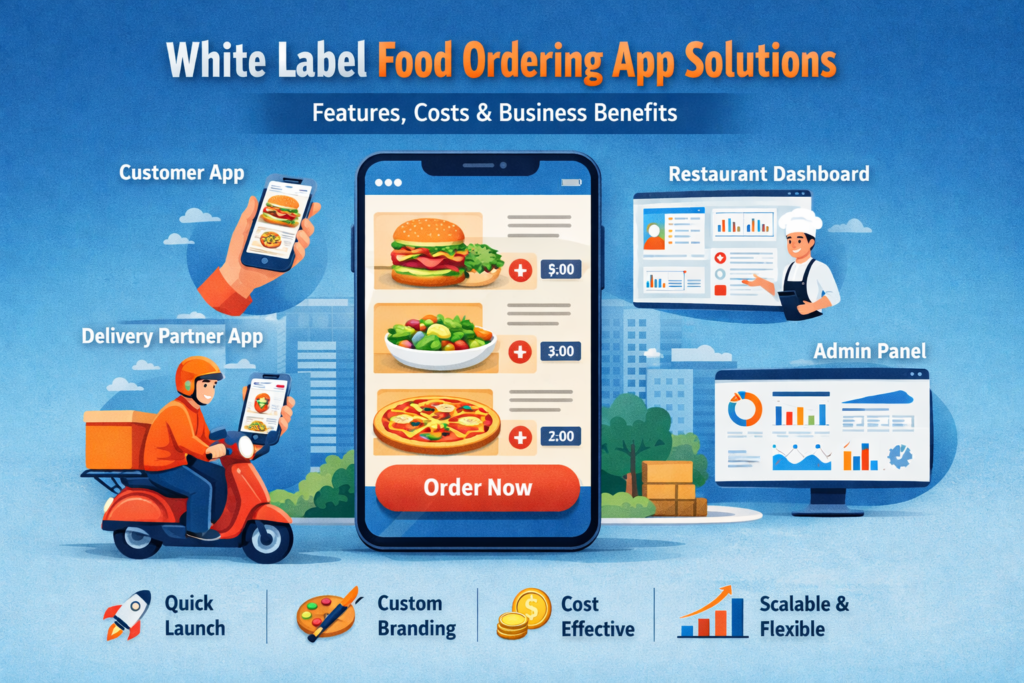
The system usually includes multiple panels: a customer app, a restaurant dashboard, a delivery partner app, and an admin panel. Customers browse menus, place orders, and make payments. Restaurants receive and manage orders, update menus, and track earnings. Delivery partners handle logistics, while admins oversee the entire ecosystem, manage commissions, promotions, and performance metrics.
Because the foundation is already in place, the launch timeline is significantly shorter compared to custom development.
Why Businesses Prefer Readymade Food Delivery App Solutions
The growing popularity of the Readymade Food Delivery App model is driven by practical business advantages. These solutions eliminate the uncertainty of development timelines and reduce technical risks. Businesses gain access to proven architecture that has already been deployed in real-world scenarios.
Another key reason is scalability. A readymade solution is designed to support growth, whether that means onboarding more restaurants, expanding to new cities, or handling peak order volumes. This allows startups and established businesses alike to scale without rebuilding the platform.
Additionally, white label solutions enable faster market entry. In highly competitive food delivery markets, speed often determines success. Launching quickly allows businesses to acquire users, test strategies, and optimize operations before competitors catch up.
Core Features That Power White Label Food Ordering App Platforms
Customer-Focused Ordering and Experience Features
A successful platform prioritizes customer convenience. White label food ordering apps typically include intuitive navigation, advanced search and filter options, and detailed restaurant listings. Customers can browse cuisines, view ratings, read reviews, and customize their orders easily.
Real-time order tracking enhances transparency and trust. Push notifications keep users informed about order confirmation, preparation status, dispatch, and delivery. Multiple payment options, including cards, wallets, UPI, and cash on delivery, further improve the user experience and reduce checkout friction.
Restaurant Management and Operations Capabilities
Restaurant partners rely on robust management tools to handle daily operations efficiently. A white label solution provides a dedicated dashboard where restaurants can manage menus, pricing, availability, and preparation times. Order management tools help staff accept, reject, or delay orders based on capacity.
Sales reports and performance analytics allow restaurant owners to identify best-selling items, peak hours, and revenue trends. These insights support better inventory planning and menu optimization, directly impacting profitability.
Delivery and Logistics Management Features
Efficient delivery is critical to customer satisfaction. Most platforms include a delivery partner app that provides route optimization, order assignment, and real-time navigation. Delivery agents can update order statuses and communicate with customers when necessary.
From the admin perspective, delivery management tools help allocate orders intelligently based on location, availability, and workload. This reduces delays and improves overall service reliability.
Admin Control, Analytics, and Growth Tools
The admin panel acts as the command center for the entire platform. Business owners can manage users, restaurants, delivery partners, commissions, service areas, and promotional campaigns from a single interface.
Advanced analytics provide visibility into order volumes, revenue, customer retention, and operational efficiency. These insights enable data-driven decisions, helping businesses refine pricing strategies, marketing campaigns, and expansion plans.
Cost Structure of White Label Food Ordering App Solutions
Key Factors That Influence Overall Cost
The cost of launching a White Label Food Ordering App depends on several variables. Customization depth plays a major role; basic branding adjustments cost less, while advanced UI changes and feature enhancements increase investment. Platform coverage, such as Android, iOS, and web admin panels, also affects pricing.
Another factor is third-party integrations. Payment gateways, map services, SMS and push notification services, and analytics tools may involve additional setup and usage fees. Hosting infrastructure and security measures further influence long-term costs.
Typical Cost Ranges and What They Include
Compared to building from scratch, white label solutions are significantly more cost-effective. Entry-level packages usually include core features, standard branding, and basic support. Mid-range options add advanced analytics, marketing tools, and multi-city capabilities. Premium packages offer deep customization, scalability enhancements, and dedicated technical support.
While prices vary by provider, businesses generally save a substantial amount on development time and engineering resources. This makes white label solutions attractive for startups and growing enterprises with limited upfront budgets.
Ongoing Expenses to Plan For
Beyond initial setup, businesses should account for ongoing costs. These may include hosting, maintenance, updates, and customer support. Marketing and customer acquisition expenses also play a crucial role in overall profitability.
Working with reliable food delivery app development services ensures that ongoing technical needs are handled efficiently, allowing businesses to focus on operations and growth rather than platform maintenance.
Business Benefits of Choosing a White Label Food Ordering App
Faster Time to Market and Competitive Advantage
One of the most significant advantages is speed. Launching within weeks instead of months allows businesses to capture market demand quickly. This agility is especially valuable in local markets where competition is intense and customer loyalty is still forming.
Reduced Technical Complexity and Risk
With a readymade solution, businesses avoid common development challenges such as bugs, scalability issues, and security vulnerabilities. The platform has already been tested and optimized, reducing the risk of costly failures after launch.
Brand Ownership and Direct Customer Relationships
Unlike third-party marketplaces, a white label app enables businesses to own their brand and customer data. Direct access to customer insights supports personalized marketing, loyalty programs, and long-term relationship building.
Scalable Growth and Revenue Opportunities
White label platforms are designed to grow alongside the business. New restaurants, delivery partners, and service areas can be added without major technical changes. Revenue streams may include commissions, delivery fees, subscription models, and promotional placements.
Choosing the Right Food Delivery App Development Services Partner
Selecting the right technology partner is critical to long-term success. Businesses should evaluate providers based on platform stability, customization options, scalability, and post-launch support. Transparent pricing, regular updates, and a proven track record in food delivery app development services indicate a reliable partner.
It is also important to assess whether the provider understands local market requirements, payment preferences, and regulatory considerations. A solution that aligns with business goals and operational workflows will deliver the best results over time.
Future Trends Shaping White Label Food Ordering Platforms
The food delivery industry continues to evolve with technology. AI-driven recommendations, dynamic pricing, and demand forecasting are becoming more common. Integration with POS systems, inventory management tools, and CRM platforms is also gaining traction.
Sustainability features, such as eco-friendly packaging options and optimized delivery routes, are increasingly valued by customers. White label solutions that adapt to these trends will help businesses stay relevant and competitive in the long term.
Conclusion
White Label Food Ordering App solutions offer a practical, cost-effective, and scalable path for businesses looking to succeed in the on-demand food economy. By leveraging a Readymade Food Delivery App, companies can launch quickly, reduce technical risks, and focus on customer experience and growth. With the support of experienced food delivery app development services, businesses gain a powerful platform that supports branding, operations, and long-term expansion.
Frequently Asked Questions
How is a white label food ordering app different from custom development?
A white label solution is pre-built and customizable, allowing faster deployment at a lower cost. Custom development starts from scratch and requires more time, budget, and technical resources.
Can a white label food ordering app support multiple restaurants and cities?
Yes, most platforms are designed to scale across multiple restaurants, locations, and delivery zones without major technical changes.
Is customization limited in a readymade solution?
Customization options depend on the provider. While the core architecture remains the same, branding, features, and workflows can usually be tailored to business needs.
What kind of support is included after launch?
Reputable providers offer ongoing maintenance, updates, and technical support. The level of support varies by package and service agreement.
Is a white label food ordering app suitable for small restaurants?
Yes, these solutions are suitable for both small restaurants and large aggregators. They allow smaller businesses to compete digitally without heavy upfront investment.