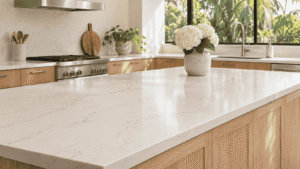
The counter looks clean until you move the soap bottle and find a pale ring underneath. There’s another one around the faucet base, right where water collects when you turn it off with wet hands. If you’re considering quartz countertop repair in Tampa Bay, first check whether you’re seeing buildup on the surface or a change in the finish itself. A deposit left by water may respond to the right cleaning method. A patch that stays dull after the deposit is gone needs a different look.
Start With Where the Water Sits
Clear the area beside the sink and look at the marks while the countertop is dry. Is there a narrow ring around the faucet? Does a mark follow the edge of a soap bottle or drying mat? Are there several small spots where drops usually land? Caesarstone’s care guidance explains that hard water can leave mineral deposits on quartz. A mark appearing where water regularly dries is a clue worth checking.
Keep other possibilities open. A pale patch near the faucet might also be cleaner residue or something left behind during installation. Look at its shape and think about when it first appeared. If it’s been there since the faucet was fitted, mention that when you ask about it. If it shows up in several places where water collects, note those locations. The pattern helps you decide what to investigate without having to identify a stain by color alone.
Check Which Surface Has the Buildup
Look at the faucet base, the quartz, and the joint where they meet. Some of the mark may be on the metal or around the fixture rather than on the countertop. If the faucet has a coated finish, find its care instructions as well as the countertop guide. A product recommended for one surface may be unsuitable for the other.
Take a close photo from above and another from the side if the deposit appears raised. You don’t need to scrape it to see whether there’s material on top. If the line seems to sit beneath the faucet base, avoid pulling at the fixture or seal. Ask the installer to identify what you’re seeing. This matters when the area has recently been worked on: a line of sealant and a ring that appeared after water dried can look similar at a glance.
Clean and Dry the Area Before Judging the Mark
Find the countertop brand and finish on your invoice or installation documents. Follow the manufacturer’s everyday cleaning method first. Cambria, for example, recommends warm water and a soft cotton cloth for its quartz, with mild soap if needed. Caesarstone’s routine instructions include cleaning, rinsing away residue, and drying the surface. Use the directions that apply to your product.
Once the area is dry, look at it again under the same light. A little water can make a pale spot harder to see temporarily, so judging the surface while it’s still wet can be misleading. If the mark disappeared, you can focus on keeping the area dry during normal use. If it’s lighter but still visible, note what changed. If it hasn’t changed at all, check whether the manufacturer has separate instructions for mineral buildup. You’ll get more useful advice if you can explain what happened after the first cleaning.
Get Product-Specific Advice for a Stubborn Ring
You may find several suggestions for removing scale. Before using any of them, confirm that the maker of your countertop recommends that product or method for your finish. Caesarstone provides specific guidance on hard-water spots for its surfaces. Cambria’s care guide, by contrast, lists products and types of cleaners to avoid on its quartz. That difference matters more than whether a cleaner says it’s suitable for stone on the front of the bottle.
If the care guide doesn’t answer your question, contact the manufacturer or fabricator. Tell them where the ring is and whether it reaches the faucet, sink rim, or a joint. Ask what they approve for that exact setup. Skip the metal scraper and don’t try a stronger product simply because the first one didn’t work. If the mark is small, you want to avoid turning it into a larger patch with a different sheen.
Find Out Why the Same Spot Keeps Getting Wet
If the ring returns, dry the area and pay attention to when it becomes wet again. You might notice water after someone reaches for the faucet with wet hands or after a bottle is set back down without being dried. Those are situations you can address by moving an item or wiping the area after use. Try giving a soap bottle or drying mat a different spot and see whether that changes where the water collects.
Water that keeps appearing even when nobody has been using the sink deserves a separate look. Note where you see it and ask a plumber to check for a leak if you suspect one. Tell them if you’ve also found moisture inside the cabinet. Cleaning a ring deals with what’s visible on the surface. It won’t tell you whether water is coming from a fixture or connection that needs attention.
Ask for an Assessment if the Finish Still Looks Different
Look at the affected area from the spot where you normally stand to wash dishes. If the buildup is gone but the quartz still looks dull, take a photo that includes some of the unaffected surface. Describe the result of cleaning as specifically as you can: “The raised ring is gone, but there’s a pale patch I can still see in daylight.” That tells the fabricator more than calling it a water stain after the visible deposit has been removed.
If you see a crack, a change at the sink rim, or a joint that’s opened, photograph that separately and ask the installer to check it. A buildup problem and a change in the installation don’t have to be connected. Let the person inspecting the area explain which part needs cleaning, repair, or further investigation before you agree to the work.
Keep the Care Routine Easy to Repeat
Put a clean drying cloth somewhere you can reach it after washing dishes. Leave enough room around the faucet to wipe behind it without moving several bottles first. If you normally keep a tray beside the sink, lift it during cleanup so you can see whether water is sitting beneath it.
A small change in where you set wet things can make the area easier to maintain. Start by finding the places water collects and following the care instructions for your surface. If a ring keeps returning or the finish still looks different after approved cleaning, you’ll have a clear description and photos ready for the person who can assess it.