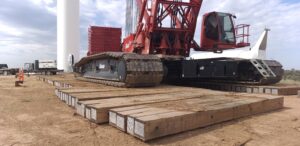
Ask three crane crews how they picked their mat size and you will hear three answers: whatever the last job used, whatever the yard had in stock, or whatever the spec sheet said. None of those is a sizing method. A crane mat should be sized by the load it carries, the ground it sits on, and the material it is made from. Get one of those wrong and the mat is either overbuilt and expensive, or undersized and unsafe.
This guide walks through how to size a crane mat, step by step. For the full picture on species, grade, and cost, see our Crane Mats Guide.
Start With the Load, Not the Mat
What Is Actually Resting on the Mat
Sizing starts with the crane, not the catalog. The crane manufacturer’s load chart and your lift plan give the maximum outrigger or track reaction for the lift. That reaction, not the crane’s rated capacity, is the number the mat has to handle. Equipment type matters too: a mobile crane on outriggers puts its weight into a few small pads, while a crawler spreads weight along its tracks.
Why Total Crane Weight Is the Wrong Number
Most mat failures do not come from exceeding a mat’s total rated capacity. They come from concentrated point loads at one contact area, or from voids in the ground that no one knew about. Cranes and booms also shift slightly during a lift, so loads move across the mat. A crane that looks fine on paper by total weight can still overload a mat under a single outrigger pad.
The Three Measurements That Define Mat Size
Thickness and the Square-of-Thickness Rule
Weight capacity changes with roughly the square of the thickness times the material’s bending strength (modulus of rupture, MOR, in PSI). That makes thickness the most important dimension, and it is why an undersized mat is not a rounding error. A 12 inch mat that actually measures 11 inches has lost close to a sixth of its rated capacity (144 square inches versus 121). Always confirm true delivered thickness.
Width: Why True 48 Inch Matters
Width sets how much ground each mat covers and how fully it supports an outrigger pad. Many mats sold as 48 inch are narrower in hand. World Forest Group’s Eucalyptus mats are a true 48 inches, and our 10 inch crane mats run a symmetrical 50 inch width. A true 48 inch mat can also cut the number of mats a job needs; see our guide on why a true 48 inch mat can save hundreds of mats.
Length: 16, 18, and 20 Foot
Twenty foot mats are the length most often quoted, but the extra length rarely adds usable bearing area under a stationary outrigger pad. Buyers who default to 20 foot are often paying a 10 to 20 percent premium for length they cannot use. Choose length to cover the pad and the working area, not to match habit.
Matching Thickness to Load Level
- 4 to 5 inch: Solar and battery storage sites, which are generally well improved and have light equipment loads where ease of handling matters more than raw thickness.
- 6 to 8 inch: Access roads, laydown areas, and light to medium loads where crane-level ratings are not required.
- 10 to 12 inch: Cranes, rigs, and anything producing concentrated outrigger or track loads. Twelve inch high-MOR mats with Grade 36 or better bolts are typical for crane work.
Species Changes What Size You Actually Need
Thickness alone does not tell you capacity. Oak runs roughly 550 PSI MOR at #2 grade and about 1,000 PSI at #1 grade. “Mixed hardwood” is a marketing term, not a technical category, and its MOR can fall anywhere from roughly 550 to 1,000 PSI depending on what is in the mat. Eucalyptus runs around 2,000 PSI, so it can substitute down in thickness:
| Eucalyptus thickness | Equivalent mixed hardwood #2 | Typical application |
|---|---|---|
| 6 inch | ~11 inch | Light to medium loads |
| 6.75 inch | ~9.5 to 12 inch | Standard access |
| 10 inch | ~14 to 18 inch | Heavy crane mats |
| 12 inch | ~17 to 20 inch | Extreme lifts |
Values vary by supplier, drying process, and grade. Ask for a documented MOR rating, not a nominal size, and confirm the final spec with a qualified person.
Ground Conditions Change the Math
OSHA 1926.1402 treats ground conditions (slope, compaction, firmness) as separate from the supporting material, and places responsibility for adequate ground on the controlling entity, or on the employer if there is none. A correctly sized mat on saturated or unstable ground still will not perform to its rating, because a mat is only as stable as what it rests on.
For very large lifts, plan with ground LIDAR to find voids, or confirm the ground has been improved with gravel or similar fill. On soft or uneven ground, build in a larger safety margin.
Size, Freight, and Total Cost
Size drives cost well beyond the sticker price. At roughly $1,500 per truckload, a 12 inch Eucalyptus load fits around 11 new mats, against roughly 10 for a comparable mixed hardwood load. Lifespan matters just as much: Eucalyptus typically lasts 5 to 7 years against oak’s 2 to 3, which lowers cost per mat-month. Right-sizing is a cost decision as well as a safety decision. Run your numbers through our total cost of ownership calculator and freight savings calculator.
A Simple Framework for Choosing Your Mat Size
Step-by-Step Sizing Checklist
- Get the maximum outrigger or track reaction from the load chart and lift plan.
- Assess ground conditions and bearing capacity, and improve the ground if needed.
- Choose a thickness range based on load level.
- Adjust for species using documented MOR, not nominal size.
- Choose width and length to fully support each pad and the working area.
- Verify true delivered dimensions before mats go on site.
- Have a qualified person confirm the plan against OSHA 1926.1402.
Common Mistakes That Undo a Correct Size Choice
- Using total crane weight as the sizing number.
- Choosing thickness without species and grade.
- Trusting nominal dimensions instead of true dimensions.
- Defaulting to 20 foot length.
- Ignoring ground conditions.
Frequently Asked Questions
What thickness crane mat do I need for a 200-ton crane?
There is no single answer by tonnage. Size from the maximum outrigger or track reaction on the load chart, plus ground conditions and species. For most crane classes, 12 inch high-MOR mats are the standard starting point.
Is a 6 inch Eucalyptus mat really equivalent to a thicker mixed hardwood mat?
Against a #2 mixed hardwood mat, roughly yes, because Eucalyptus runs around 2,000 PSI MOR versus roughly 550 PSI. Always request documented MOR ratings before substituting.
What happens if my mat is undersized by an inch?
A 12 inch mat measuring 11 inches loses close to a sixth of its rated capacity. Thickness shortfalls are real capacity losses, not rounding errors.
Do longer mats provide more load capacity?
Usually not under a stationary outrigger pad. Extra length mostly adds cost, often a 10 to 20 percent premium, without adding usable bearing area.
How do I confirm a supplier’s mats are true to size?
Request documented dimensions and MOR ratings, measure thickness and width on delivery, and reject shortfalls before the mats go under a crane.
Next Steps
Ready to size your next lift? Run the numbers through our total cost of ownership calculator, or contact our team for a documented MOR rating and a quote on your crane mat order.