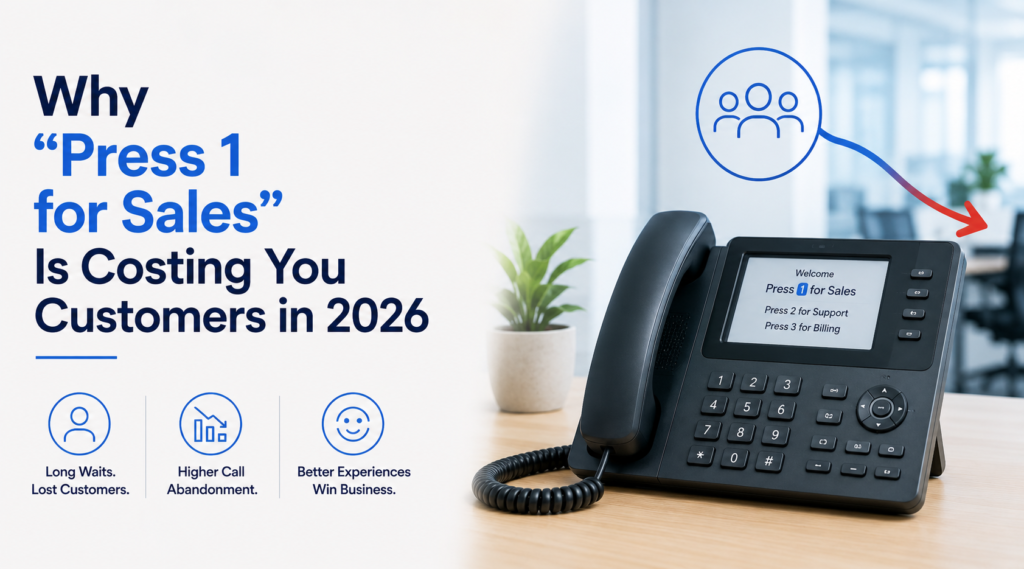
Why "Press 1 for Sales" Is Costing You Customers in 2026
Picture a customer calling your business with a simple question. Instead of getting an answer, they hear a recorded voice list five menu options, none of which quite match what they need. They press a number anyway, land in another menu, wait on hold, and eventually hang up. That customer does not call back. They call your competitor instead.
This scene plays out thousands of times a day across every industry, and it is one of the most overlooked reasons businesses lose customers before a conversation even starts. The old fashioned phone menu, once considered a sign of a professional operation, has quietly become a liability.
The Menu Was Never Built for the Caller
IVR systems, short for Interactive Voice Response, were designed decades ago to solve a staffing problem, not a customer experience problem. Routing large volumes of calls to the correct department without hiring more receptionists made financial sense at the time. The tradeoff was that callers had to adapt to the company’s internal structure instead of the company adapting to what the caller actually needed.
That tradeoff made sense when phone calls were the only option and customers had few alternatives. It makes far less sense now. Today’s customers compare every interaction, including a two minute phone call, against the instant, personalized experiences they get from apps, websites, and messaging platforms. A rigid menu tree feels outdated by comparison, and outdated experiences quietly push people toward whoever answers faster.
The Real Cost Hiding Behind Those Menus
The financial impact of a bad phone menu rarely shows up on a spreadsheet labeled “lost customers due to IVR,” but it is there. Every additional step a caller has to take before reaching a real answer increases the odds they abandon the call. Every abandoned call is a lead, a booking, or a sale that simply disappears.
Consider a home service company fielding an emergency repair call. The customer is stressed, needs help fast, and does not have patience for “press 1 for scheduling, press 2 for billing, press 3 to speak with a representative.” If they cannot get through quickly, they move on to the next search result. The same pattern applies to medical offices, retail stores, and any business where speed signals reliability.
This is exactly the tension explored in our breakdown of AI Agent vs IVR, which looks at how these two approaches perform when measured purely on customer satisfaction rather than internal convenience. The conclusion is consistent across industries: menus that prioritize routing over understanding tend to frustrate the exact customers a business is trying to keep.
Why 2026 Is a Turning Point
A few years ago, customers tolerated phone menus because there was no real alternative. That has changed. Conversational AI has matured to the point where a caller can simply say what they need, in plain language, and get a real response without navigating a single button press. Once customers experience that kind of service from one business, they start expecting it everywhere.
This shift puts pressure on any company still relying on a traditional IVR setup. It is no longer just about losing a few impatient callers. It is about losing customers to competitors who have already modernized their front line communication and made the choice to answer the phone the way people actually want to talk.
What Replaces the Menu
The alternative to a rigid IVR tree is a conversational AI agent trained on the specifics of a business, its services, its hours, its pricing, and its booking rules. Instead of asking a caller to fit their request into a preset category, the AI agent listens and responds naturally. A caller who says “I need to move my appointment to Thursday” gets exactly that handled, without ever hearing a single numbered option.
This approach also solves the availability problem that IVR never fully addressed. Most menu systems still depend on a live person picking up eventually, which means coverage is limited to business hours. An AI agent can independently manage calls at any hour, including nights, weekends, and holidays, so a business stops losing after hours callers to voicemail or, worse, to a competitor who happened to answer.
None of this works well without solid infrastructure underneath it. Businesses making this shift are pairing AI agents with reliable Voice & UCaaS solutions Tampa companies trust for consistent call quality and uptime. Getting the technology and the infrastructure right together is what actually delivers the improvement, rather than layering AI on top of a shaky phone system and expecting different results.
Signs Your Menu Is Already Costing You
A few warning signs tend to show up before the revenue impact becomes obvious. If your team frequently hears “just give me a real person” within the first few seconds of a call, that is a sign the menu options are not matching what customers actually need. If your call logs show high abandonment rates during the opening seconds of a call, that is callers giving up before they even reach a live person. If your competitors have started advertising instant phone response or 24 hour availability, that is a signal the market is already moving past the old menu model.
None of these signs are dramatic on their own, but together they point to a slow erosion of trust every time a customer picks up the phone.
Making the Shift Without Disrupting Operations
Switching away from a traditional phone menu does not mean ripping out your entire communication setup overnight. Many businesses start by identifying the calls that cause the most friction, typically scheduling, general inquiries, and after hours calls, and handing those specifically to an AI agent while keeping existing infrastructure in place. Over time, as confidence builds, more of the call volume shifts toward conversational handling.
The goal is not simply to modernize for the sake of modernizing. It is to remove the friction that quietly pushes customers toward competitors who already answer faster and more naturally.
Final Thoughts
“Press 1 for sales” once felt like a normal part of calling a business. In 2026, it increasingly feels like a red flag that a company has not kept pace with how customers expect to be treated. Every extra menu layer is a chance for a customer to give up and look elsewhere, and that cost adds up far faster than most businesses realize.
Companies ready to close that gap are turning to partners who understand both the AI side and the voice infrastructure side of the equation. That is where Omnicaas comes in, helping businesses replace outdated phone menus with a system that actually listens, so every caller gets a real answer instead of another button to press.