Basement flooding is rarely as simple as “water got into the basement.” Where that water came from matters because different sources require different forms of protection.
Two devices homeowners often hear about when discussing basement flood prevention are sump pumps and backwater valves. Because both are associated with keeping basements dry, it is easy to assume they perform roughly the same job. They do not.
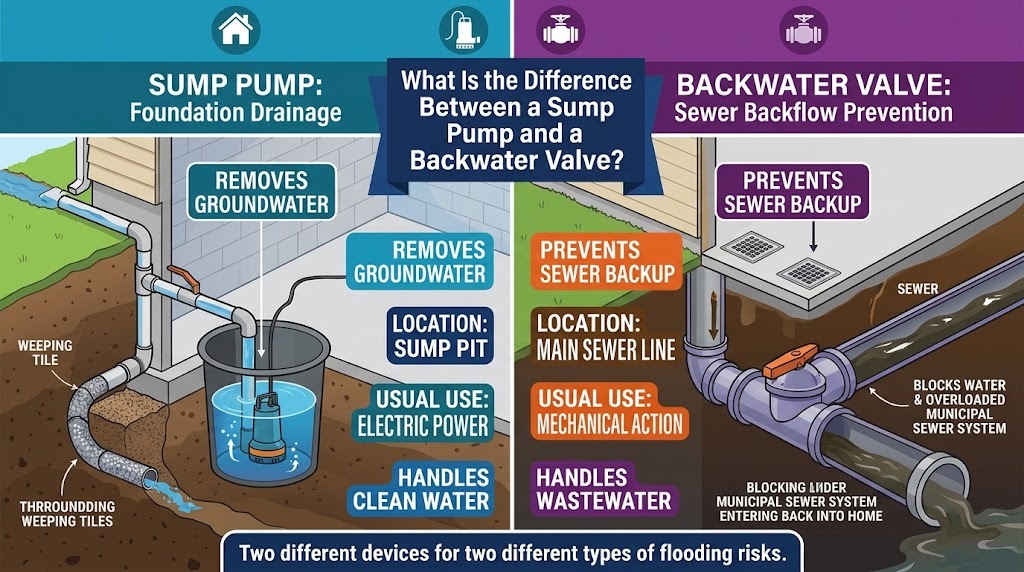
A sump pump is primarily designed to collect and remove groundwater or drainage water from around the foundation. A backwater valve, on the other hand, is designed to stop water or sewage in a sewer line from reversing direction and entering the home.
That distinction is important. Installing a sump pump will not necessarily protect a basement from a municipal sewer backup, while installing a backwater valve will not solve groundwater accumulating around the foundation.
Understanding how each system works makes it much easier to determine which one your property may need and why, in some homes, having both makes sense.
What Is a Sump Pump?
A sump pump is an electrically powered pump typically installed in a sump pit or basin at the lowest part of a basement.
Water collected by foundation drains, often called weeping tiles, can be directed into this basin. As the water level in the pit rises, a float or similar mechanism activates the pump. The pump then moves the collected water through a discharge pipe and away from the house.
Its purpose is relatively straightforward: remove water before it can rise high enough to enter or flood the basement.
Sump pumps are particularly relevant to properties where groundwater, rainwater or melting snow can collect around the foundation. Homes in areas with high water tables, poor natural drainage or recurring heavy rainfall may depend heavily on an effective foundation drainage system.
A sump pump should therefore be viewed as part of a larger water-management system rather than as an isolated appliance. The condition of the weeping tiles, sump basin, discharge piping, grading and foundation all influence how effectively water is controlled.
Homeowners dealing with recurring groundwater around a basement can learn more about professional sump pump and basement drainage solutions and how these systems fit into a broader waterproofing strategy.
What Is a Backwater Valve?
A backwater valve is a plumbing device installed in a building’s sewer line. Instead of pumping water away, it helps prevent sewage or stormwater from moving backward through the pipe and into the home.
Under normal conditions, wastewater from sinks, toilets, showers and other plumbing fixtures flows away from the house toward the municipal sewer system. The backwater valve remains open so this normal flow can continue.
Problems can occur when the municipal sewer becomes overloaded, particularly during severe rainfall or when a blockage creates unusually high pressure within the sewer system. Water may then attempt to travel in the opposite direction through the home’s sewer connection.
A properly installed backwater valve is designed to react to this reverse flow by closing the pipe. This creates a physical barrier intended to stop backed-up sewer water from entering the building through floor drains, toilets or other low-level plumbing fixtures.
Unlike a sump pump, a backwater valve does not collect water, pump groundwater or reduce the water table around the foundation.
Its job is simply to control the direction of flow through a sewer pipe.
Sump Pump vs. Backwater Valve: The Main Difference
The simplest way to remember the distinction is this:
A sump pump removes water from around or beneath the foundation. A backwater valve prevents water from coming backward through the sewer system.
Here is how the two compare:
| Feature | Sump Pump | Backwater Valve |
|---|---|---|
| Primary purpose | Removes collected groundwater | Prevents sewer backflow |
| Typical location | Sump basin below basement floor | Main sewer line |
| Handles groundwater | Yes | No |
| Protects against sewer backup | Not directly | Yes |
| Uses electricity | Usually | Normally no |
| Actively moves water | Yes | No |
| Connected to foundation drainage | Commonly | Not for the same purpose |
| Requires maintenance | Yes | Yes |
Although both can reduce basement flood risk, they address completely different pathways through which water may enter a home.
What Type of Water Does a Sump Pump Handle?
A sump pump generally deals with relatively clean groundwater or drainage water rather than sewage.
Imagine heavy rain saturating the soil surrounding a house. Water moves downward through the ground and begins collecting around the footing and foundation.
A functioning weeping tile system intercepts some of that water and directs it toward the sump basin. Once the basin reaches a predetermined level, the pump switches on and sends the water to an appropriate discharge point.
Without an effective drainage route, hydrostatic pressure can build around the foundation. Water may eventually find openings through foundation cracks, joints, porous masonry or the connection between the basement wall and floor.
This is why a sump pump can be an important component of an interior drainage or basement waterproofing system.
However, a pump cannot compensate for every possible problem. Cracked foundation walls, blocked drainage systems, improper grading and defective window wells may require separate repairs.
What Type of Water Does a Backwater Valve Handle?
A backwater valve deals with water attempting to return through the sewer connection.
During intense rainfall, municipal storm or combined sewer systems can sometimes receive large volumes of water in a short period. If the sewer becomes overloaded, the level inside the system may rise.
Without suitable protection, sewage or stormwater can potentially travel backward through a property’s sewer lateral.
Basements are particularly vulnerable because their plumbing fixtures and floor drains are typically among the lowest openings in a building.
A backwater valve is intended to close when this reverse flow occurs.
There is an important practical point homeowners should understand. While the valve is closed, wastewater produced inside the house cannot simply pass through it in the usual direction. Plumbing use should therefore be minimized until the valve reopens and normal drainage is restored.
Do You Need a Sump Pump or a Backwater Valve?
The answer depends mainly on where your basement’s flood risk originates.
You May Need a Sump Pump If:
Your property experiences groundwater intrusion, water around the foundation or problems associated with the water table.
Common warning signs can include:
- Water appearing near the basement floor or wall-floor joint
- Dampness after prolonged rainfall
- Water entering during spring snowmelt
- A history of groundwater seepage
- Existing weeping tiles that need a reliable discharge point
- A sump pit that fills with water but has an inadequate or failing pump
In these situations, investigating the foundation drainage system is usually more useful than focusing only on the visible puddle.
You May Need a Backwater Valve If:
Your primary concern is sewage or municipal sewer water backing up into the basement.
Warning signs may include:
- Previous sewer backups during heavy rainfall
- Wastewater entering through basement floor drains
- Sewage appearing at low-level plumbing fixtures
- Neighbouring homes experiencing sewer backups during storms
- A property located in an area with known sewer surcharge problems
A licensed plumbing professional can inspect the drainage configuration and determine whether a backwater valve is appropriate and where it should be installed.
Can a House Have Both?
Yes. In fact, sump pumps and backwater valves can complement one another because they protect against different flooding mechanisms.
Consider a home exposed to two separate risks.
Heavy rainfall may saturate the surrounding soil, producing groundwater that needs to be collected by the weeping tile system and removed using a sump pump.
At the same time, the same storm could place pressure on the municipal sewer network, potentially creating a sewer backup. A backwater valve addresses that second risk.
One device does not automatically make the other unnecessary.
For properties with a history of water problems, a complete assessment is often more useful than deciding in advance that one particular product is the solution. Basement leaks can originate from foundation cracks, poor grading, damaged drainage systems, window wells, groundwater or sewer infrastructure.
When the source is uncertain, a broader assessment of available basement waterproofing and foundation repair options can help homeowners understand whether the problem starts outside the foundation, below the floor or within the plumbing system.
What Happens During a Power Outage?
This is an important difference between the two systems.
Most residential sump pumps rely on electricity. Unfortunately, major storms can cause power outages at exactly the time a sump pump may be needed most.
Without electricity, a standard pump may stop operating while groundwater continues entering the sump basin.
For that reason, homeowners in higher-risk properties often consider a battery backup system or another approved secondary pumping arrangement.
A conventional backwater valve is different. It generally functions mechanically as water changes direction in the pipe, meaning its basic operation does not normally depend on household electricity.
That does not make it maintenance-free, however.
Maintenance Matters for Both Systems
Flood-protection equipment is only useful if it works when needed.
Sump Pump Maintenance
A sump pump should be checked periodically to ensure the pump activates correctly and the float mechanism can move freely.
Homeowners should also inspect the basin for excessive sediment, examine the discharge piping and ensure that discharged water is being carried far enough away from the foundation rather than simply returning to the same area.
Battery backup systems also require attention. Batteries have limited service lives and should be inspected and replaced according to manufacturer recommendations.
Backwater Valve Maintenance
A backwater valve should remain accessible after installation.
Over time, debris can accumulate around the flap or gate and interfere with its ability to close completely. Regular inspection and cleaning are therefore important.
The valve should never simply be installed beneath a finished floor and forgotten.
Follow the manufacturer’s maintenance requirements and any applicable municipal recommendations.
Installation Is Not the Same for Every House
Neither sump pumps nor backwater valves should be treated as one-size-fits-all products.
A sump system has to account for factors such as the volume of groundwater entering the property, condition of the foundation drains, basin size, pump capacity, discharge location and availability of backup power.
Backwater valve installation requires similar care. The building’s plumbing configuration must be understood so that the correct line is protected without creating drainage problems elsewhere.
Local building codes, plumbing regulations and permit requirements may also apply. Some municipalities offer basement-flooding prevention programs or rebates for qualifying installations, so homeowners should check current local requirements before starting work.
Professional assessment becomes particularly important in older properties, where plumbing and foundation drainage may have been altered several times over the life of the building.
A Sump Pump Does Not Waterproof the Entire Basement
One common misconception deserves special attention.
Installing a sump pump does not automatically make a basement waterproof.
The pump deals with water that successfully reaches the sump basin. It cannot seal a leaking foundation crack, repair deteriorated masonry, correct improperly sloped landscaping or restore a collapsed section of weeping tile.
Likewise, a backwater valve cannot prevent rainfall from entering through a window well or groundwater from seeping through a foundation wall.
Effective basement flood prevention begins by identifying the pathway water is using.
Once that pathway is known, the appropriate combination of drainage improvements, waterproofing repairs, pumping equipment and plumbing protection can be selected.
Which One Is More Important?
There is no universal winner in the sump pump vs. backwater valve comparison.
If groundwater is your primary concern, the sump pump may be essential while a backwater valve does little to address the immediate problem.
If sewer backup is the primary threat, the backwater valve may be critical while a sump pump offers little direct protection from sewage entering through the sewer lateral.
And if your house is vulnerable to both conditions, both systems may form part of a more complete flood-prevention strategy.
The important thing is to diagnose the risk before choosing the solution.
Final Thoughts
A sump pump and a backwater valve may both help protect a basement, but they do so in fundamentally different ways.
A sump pump actively moves groundwater or drainage water away from the foundation after it has been collected in a sump basin. A backwater valve sits within the sewer line and closes when wastewater attempts to flow backward toward the house.
Think of the sump pump as water removal and the backwater valve as reverse-flow prevention.
Knowing that distinction can prevent homeowners from investing in the wrong solution while leaving the actual source of flooding untouched.
If a basement repeatedly becomes wet, the most useful first step is not simply asking which device to buy. Determine where the water is coming from, inspect the relevant foundation and plumbing systems, and then choose protection designed for that specific risk.
A dry basement usually depends less on a single device and more on making sure every part of the property’s drainage system is doing the job it was designed to do.