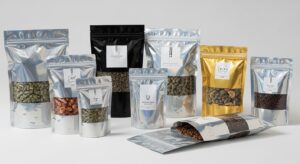
Go down any coffee aisle and you will see there is a pattern. A variety of bags are tall with five clean sides and retain their shape when half full. That appearance is a result of a certain design, and food brands depend on it each year more. Flexible packaging is estimated to be in the global market worth more than 250 billion dollars; industry reports show pouches continue to replace rigid jars and cans. Here we discuss the working of the flat bottom pouch style, its users and what to consider before deciding on a size.
What is the difference between this Shape and a Normal Stand-Up Pouch?
A stand-up pouch has a gusset at the bottom which is curved and therefore, when it is filled, it is likely to bulge and lean. A base made flat is broader and more stable. That steadiness assists on the busy shelves, when a bag wobbling may fall and block others.
The behavior of fills is also different. Square-shaped bags are easier to pack; thus products do not get huge air gaps. Reduced air entrapment implies reduced oxygen lying next to your food which promotes freshness. Employees also pack bags of smaller cartons with fewer corners wasted.
The same applies to shipping costs. A bag that is box-shaped takes advantage of cargo space, compared to a rounded bag. The sellers with hundreds of orders a week can see the small savings per parcel and these accumulate with time (a year).
What Products Does this Style Suit?
Top of the list is coffee. Roasted beans produce gas and lose flavor by coming in contact with oxygen and therefore, roasters should have a powerful barrier film and a one-way valve. Their branding is presented effectively on the flat shape, and the bag has a stable shape on a counter. Specialty coffee has been rapidly expanding in the last decade and so has packaging.
In second place are pet treats. Before purchasing a bag, dog owners are likely to pick it up, squeeze, and read the label. A durable bottom allows the bag to stand up even in a busy pet store and a removable lid prevents the staleness of treats in a pantry.
Some other common applications are granola, protein powder, tea, trail mix, and baking mixes. Good products of heavy or bulky type are particularly effective, since the gussets distribute the weight over a greater area. Even little or light items can be seen as lost in a big bag, so correlate the size with the item.
What are the Reasons to buy a flat bottom pouch with zipper to carry everyday foods?
A flat bottom pouch with zipper allows the customer to open, pour, and reseal the bag numerous times. And that is more important than most sellers would think. People will seldom use up a full pack of coffee or pet food in one sitting and a poor seal allows air and water to enter.
Zip quality varies. A loose and thin zipper can open when pressed, and a firm press-to-close track will close and stay closed. Test different kinds using your own product, as powders and oily snacks may cover the track and make it less grippy.
Placement also matters. There is a zipper at the top, making it very easy to access, though you must leave room above the fill line to neatly close the zipper. Incise a tear above the zipper to make customers open a new bag without using scissors.
Why Will a Flat Bottom Pouch Stand out of a Shelf?
One flat bottom pouch can either make or break a customer within a few seconds. Research into the behavior of shoppers regularly demonstrates that the majority of consumers, typically 60 to 70 percent of them, indicate that the package design is a factor in their purchase. There is weight to color, finish and layout, too.
Do not complicate the front panel. Display the name of the product, a clear image or icon, and a single most important message like roast level or flavor. Push longer information to the side and back panels. A messy front disorients the shoppers and disoriented shoppers leave.
When is a Hang Hole Pouch a Good Idea?
A Hang Hole Pouch has a punched hole at the top and therefore, is allowed to be hung on a peg or a clip strip by the store. The style ideally fits small stores, checkout counters, and convenience stores with limited floor space and where impulse purchases are a key driver of sales.
There is a design challenge of hanging. The opening should be deep enough not to weaken the seal and the film should be able to hold the weight of the product without breaking. The heavier ones require a stronger film or a bigger margin of the hole. Request your supplier regarding weight limits, and test a filled sample on an actual peg over a few days.
What Do You Do to Select Size, Film, and Order Quantity?
Begin with the weight and volume of your product, not with a guess on your catalog. Load some of the test bags, shake them and observe the settling of the product. Always leave some at the top to seal and to have the zipper and do not overstuff them, as tight bags put strain on the seams.
Then, choose a movie that fits your product. Fatty snacks and coffee require a good oxygen barrier and dry mixes may require less. Inquire about food-grade certification, and demand written evidence, not a web page. Another question that appears on the minds of many buyers is recyclable or lower-impact film and the choices are increasing every year.
Lastly, consider the amount. Minimum orders are set by suppliers, which tend to begin at a few hundred items when it comes to digital printing and reach into the thousands when it comes to traditional printing. Place a small order to test, get customer reviews and subsequently order a bigger one with more confidence.
Final Thoughts
The form of a pouch is not just about appearance. A flat bottom pouches enhances stability, evenly packs the product and provides the designers with five panels to share information. You add a nice zipper and a robust barrier film, and you will keep the freshness safe while making the customer’s life easier as well.
Think carefully and try before you buy. Test your product, sample a few products, and observe the behaviour of bags on a shelf, a box and a kitchen counter. Companies that do so can avoid reprints which are expensive to publish, reduce the amount of waste and provide a customer with a package that does the job as well as it appears.