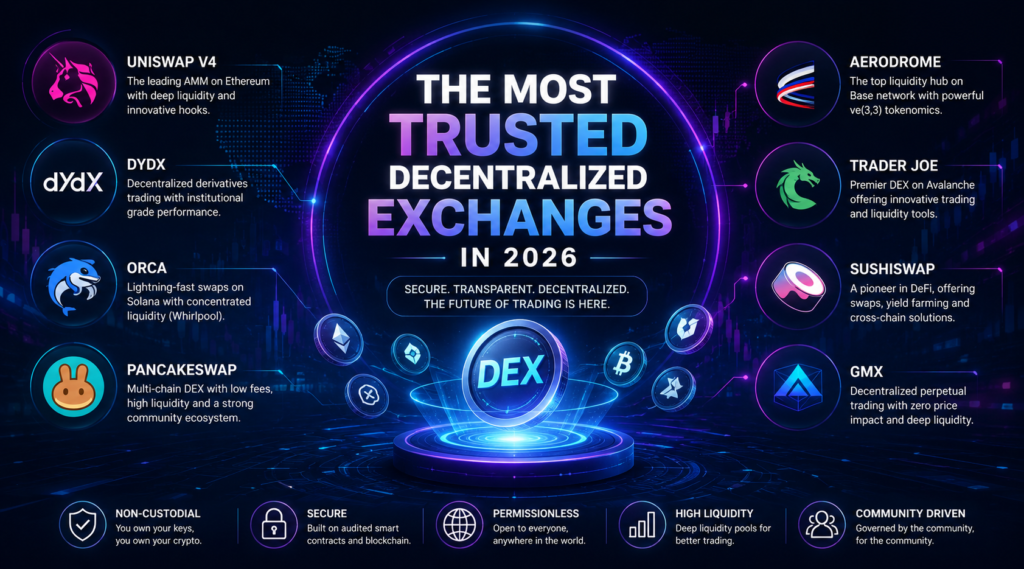
Most Trusted Decentralized Exchanges (DEXs) for Crypto Trading in 2026
Author: Mike Sandlas
Blockchain & DeFi Research Analyst
Last Updated: June 2026
Reviewed by: Web3 Engineering Team
The world of crypto trading has changed forever. Gone are the days when traders had no choice but to hand over their funds to a centralized authority and hope for the best. Today, decentralized exchanges have rewritten the rules of the game, giving power back to the people who actually own the assets. In 2026, the decentralized exchange ecosystem is not just surviving, it is absolutely thriving, processing billions of dollars in daily volume across dozens of blockchains, serving millions of users worldwide who demand transparency, security, and full control over their digital wealth. If you are a trader, investor, or business leader trying to understand where the smart money is moving and which platforms deserve your trust, this guide was written precisely for you.
What Is a Decentralized Exchange and Why Does It Matter in 2026
A decentralized exchange, commonly referred to as a DEX, is a peer-to-peer trading platform built on blockchain technology that allows users to buy, sell, and swap cryptocurrencies directly from their wallets without relying on a middleman. Unlike centralized exchanges that hold your private keys and act as custodians of your funds, a DEX operates entirely through smart contracts, self-executing pieces of code that automatically process trades when predefined conditions are met. This fundamental difference eliminates the single point of failure that has caused so many collapses of centralized exchanges in crypto history. Businesses and developers who want to build on top of this infrastructure increasingly turn to professional dex development services to create customized trading platforms that inherit all the security benefits of decentralized architecture while delivering performance that rivals traditional financial systems. The result is an ecosystem where trust is not placed in a company or a CEO but in verifiable, auditable code that operates transparently on a public blockchain.
The importance of DEXs in 2026 cannot be overstated. As institutional adoption of blockchain accelerates, regulators worldwide are beginning to formalize frameworks around DeFi, and the most reputable decentralized exchanges are positioning themselves to meet those compliance requirements while preserving the core principles of decentralization. Trading volume across DEX platforms has grown more than tenfold since 2022, and the diversity of assets, chains, and financial instruments available on these platforms has expanded dramatically. Whether you are trading meme coins on Solana, perpetual futures on a derivatives DEX, or providing liquidity in a concentrated liquidity pool on Ethereum, the opportunities available in 2026 are genuinely unprecedented.
Launch Your Secure Decentralized Exchange With Expert Developers Today→
How Decentralized Exchanges Actually Work
Understanding the mechanics behind a DEX is essential before trusting your capital to one. The majority of popular DEXs today use a system called the Automated Market Maker, or AMM, which replaces the traditional order book model used by stock markets and centralized crypto exchanges. Instead of matching buyers with sellers directly, AMMs use liquidity pools, which are smart contract-managed reserves of two or more tokens funded by liquidity providers who earn fees in return. When a trader wants to swap Token A for Token B, the AMM calculates the price based on the ratio of tokens in the pool using a mathematical formula, executes the swap automatically, and delivers the output token directly to the trader’s wallet. The entire process happens on-chain in seconds, with no human intervention required.
More advanced DEXs in 2026 have moved beyond simple AMMs to implement concentrated liquidity models, where liquidity providers can choose specific price ranges to deploy their capital rather than spreading it thinly across all price points. This dramatically improves capital efficiency and reduces the slippage that traders experience during large transactions. Some platforms have even reintroduced order book models in a decentralized form, using off-chain order matching combined with on-chain settlement to offer the speed of centralized exchanges without the custody risks. The sophistication of these systems has reached a level where even professional trading firms and hedge funds are participating actively in decentralized markets.
Uniswap V4: The Undisputed Liquidity King
When people think about decentralized exchanges, Uniswap is almost always the first name that comes to mind, and for very good reason. Since its original launch on Ethereum, Uniswap has continuously evolved, and its version 4 iteration released in late 2024 represents the most powerful AMM architecture the platform has ever offered. Uniswap v4 introduced a revolutionary feature called hooks, which are customizable smart contract extensions that allow developers to inject logic at specific points in the trading lifecycle such as before or after a swap, before or after liquidity is added, or at pool initialization. This opens the door to incredibly sophisticated trading strategies, dynamic fee structures, on-chain limit orders, and custom oracles, all built directly on top of Uniswap’s deep liquidity infrastructure.
Uniswap v4 operates across Ethereum mainnet and multiple Layer 2 networks including Arbitrum, Optimism, Base, and Polygon, giving traders access to the same deep liquidity pools at a fraction of the gas costs compared to mainnet transactions. Daily trading volume on Uniswap regularly exceeds two billion dollars, and the platform consistently holds the largest share of total DEX volume across all chains. Its open-source codebase, battle-tested security record, and massive developer community make it the benchmark against which every other DEX is measured. For anyone seeking a trusted, liquid, and technologically advanced platform for everyday crypto trading, Uniswap v4 remains the gold standard.
dYdX: Where Decentralized Trading Meets Institutional Grade Performance
For traders who want exposure to leveraged positions, perpetual contracts, and derivatives without trusting a centralized exchange, dYdX has emerged as the dominant force in decentralized derivatives trading. After making the landmark decision to migrate from Ethereum to its own sovereign blockchain built on the Cosmos SDK, dYdX v4 now operates as a fully decentralized system where even the order book and matching engine run on-chain. This is a monumental achievement because it means that no centralized server, no single company, and no single point of failure exists in the trading stack. Every order, every match, and every settlement happens transparently on a blockchain secured by an independent validator set.
The numbers behind dYdX speak for themselves. Daily perpetual trading volume on the platform routinely surpasses five billion dollars, making it one of the largest derivatives venues in the entire crypto space, centralized or decentralized. Professional traders are drawn to dYdX because it offers deep liquidity, tight spreads, leverage of up to twenty times on major pairs, and a user interface that rivals the best centralized trading terminals on the market. The platform has also implemented its own governance token and staking mechanism, allowing the community to participate in platform decisions and earn rewards for supporting network security. In 2026, dYdX represents the clearest example yet that decentralized finance can deliver genuinely institutional-grade performance without compromise.
Orca: The Speed Champion on Solana
Solana’s rise as one of the most active blockchain ecosystems in crypto has brought with it a generation of high-performance decentralized applications, and among DEXs, Orca stands out as the platform of choice for Solana traders. Built specifically to leverage Solana’s unique architecture, which can process tens of thousands of transactions per second at fees that cost fractions of a penny, Orca delivers a trading experience that feels closer to a well-designed consumer app than to the sometimes cumbersome interfaces of earlier DeFi platforms. Swaps execute in under a second, transaction costs are negligible, and the user interface is clean and intuitive enough for newcomers while offering the depth and analytics that experienced traders expect.
Orca’s technical edge comes from its Whirlpool concentrated liquidity model, which allows liquidity providers to allocate capital within specific price ranges rather than across the entire price curve. The result is dramatically better pricing for traders, reduced slippage on large swaps, and higher fee returns for active liquidity providers who manage their positions carefully. Orca is particularly popular for SOL-based trading pairs and meme tokens that launch on Solana, where speed of access and low transaction costs are critical factors. For anyone trading within the Solana ecosystem in 2026, Orca is not just an option but essentially the default choice.
PancakeSwap: Multichain Value for the Retail Trader
PancakeSwap began its journey as the flagship DEX on Binance Smart Chain, and while BNB Chain remains its primary home, PancakeSwap has undergone a significant transformation in recent years to become a genuinely multichain platform. It now operates on Ethereum, zkSync, Arbitrum, Base, and several other networks, allowing traders to access PancakeSwap’s characteristic low fees and strong liquidity regardless of which blockchain they prefer. Daily trading volume on PancakeSwap consistently exceeds $800 million, and its total value locked across chains reflects the deep trust that retail traders place in the platform.
What has kept PancakeSwap relevant and growing despite fierce competition is its ability to combine serious trading infrastructure with an engaging, gamified ecosystem. Beyond simple token swaps, users can participate in yield farming, stake CAKE tokens for governance rewards, join lottery pools, and trade NFTs, all within a single unified interface. PancakeSwap v4, launched in 2025, brought significant improvements to capital efficiency and fee optimization, making it more competitive with Uniswap for large institutional-sized trades while retaining the approachable experience that retail traders love. For anyone looking to maximize their capital across multiple chains without paying premium gas fees, PancakeSwap continues to be one of the most practical and feature-rich options available.
Aerodrome Finance: The Rising Star on Base Network
No conversation about the most trusted DEXs in 2026 is complete without acknowledging Aerodrome Finance’s remarkable rise on Coinbase’s Base network. Launched in 2023, Aerodrome has quickly grown into the dominant liquidity hub on Base, capturing a significant share of the network’s total value locked and consistently generating daily trading volumes that rival platforms many years its senior. Its success is rooted in a sophisticated ve(3,3) tokenomics model that aligns the incentives of liquidity providers, traders, and governance participants in a self-reinforcing cycle of growth, making it genuinely difficult for competing platforms to poach its liquidity.
Aerodrome’s SlipStream AMM technology is particularly noteworthy. By implementing concentrated liquidity with automated rebalancing features, it minimizes the impermanent loss risk that has historically discouraged institutional capital from participating in liquidity provision on AMM platforms. The platform’s deep integration with Base’s infrastructure and its indirect connection to Coinbase’s massive user base have also given it access to a pipeline of new users and projects that most DEXs can only dream of. For traders and liquidity providers who want to participate in one of the fastest growing blockchain networks in the world, Aerodrome represents one of the most compelling opportunities in DeFi today.
Real-World Implementation: Case Study Insights
The evolution of decentralized exchange infrastructure is closely linked with real-world engineering execution.
For example, AI-driven financial systems and automation platforms built by Suffescom demonstrate how advanced backend architecture supports scalable fintech ecosystems:
Such implementations reflect the overlapping technical foundations of modern fintech and DeFi ecosystems.
The Role of Cryptocurrency Exchange Development Services in the DEX Ecosystem
The explosive growth of decentralized exchanges has not happened in a vacuum. Behind every successful DEX is a team of highly specialized engineers, protocol designers, and security auditors who understand the nuances of smart contract development, liquidity mechanics, and blockchain scalability. This is precisely where cryptocurrency exchange development services play a transformative role in the broader ecosystem. Businesses that want to launch their own decentralized trading platform, integrate DEX functionality into an existing product, or build specialized DeFi tools on top of existing protocols rely on experienced development partners to navigate the complexity of this space safely and efficiently. From designing custom AMM curves to implementing cross-chain bridges, from conducting comprehensive security audits to deploying governance frameworks, professional cryptocurrency exchange development services provide the technical foundation that separates successful DEX projects from those that fail at launch or, worse, suffer exploits that destroy user trust overnight.
Security: The Most Important Factor When Choosing a DEX
For all the innovation and financial opportunity that decentralized exchanges represent, security remains the single most important consideration for any trader or investor choosing where to operate. Unlike centralized exchanges where hacks typically result in the exchange losing funds it holds in custody on behalf of users, DEX vulnerabilities tend to strike at the smart contracts themselves, potentially draining liquidity pools that represent the deposited funds of thousands of liquidity providers in a single transaction. The history of DeFi is unfortunately littered with examples of protocols that launched without adequate security review and suffered eight or nine figure exploits as a result.
The most trusted DEXs in 2026 distinguish themselves through multiple layers of security assurance. They have undergone repeated audits by multiple independent security firms with strong reputations in the smart contract space. They maintain active bug bounty programs that incentivize white hat hackers to identify vulnerabilities before malicious actors can exploit them. They implement timelocks and governance delays that prevent instant upgrades to protocol code, giving the community time to review proposed changes before they take effect. They also carry on-chain insurance options or partner with decentralized insurance protocols that allow users and liquidity providers to purchase coverage against smart contract failures. Trust in a DEX is not earned overnight; it is built over years of consistent security performance, transparent operations, and a demonstrated commitment to the safety of user funds.
Cross-Chain Trading and the Future of DEX Infrastructure
One of the most significant developments shaping the DEX landscape in 2026 is the maturation of cross-chain trading infrastructure. In the early years of DeFi, liquidity was almost entirely siloed within individual blockchain ecosystems. Swapping a token on Ethereum for a token on Solana required users to navigate through centralized bridges or accept significant complexity and risk. Today, a new generation of cross-chain DEX protocols and interoperability layers is beginning to dissolve these barriers, allowing assets to flow freely between chains within a single, unified trading experience.
This evolution has profound implications for how traders approach portfolio management and how businesses think about building financial products on blockchain. Rather than being forced to choose a single chain and accept its limitations, traders can now access the best liquidity wherever it exists across the entire multi-chain landscape. Layer 2 networks on Ethereum have dramatically reduced the cost of on-chain trading while maintaining the security guarantees of the Ethereum base layer. New consensus mechanisms and faster blockchains have made real-time on-chain trading viable for active traders who previously found block times too slow for their strategies. The infrastructure underpinning DEXs is advancing rapidly, and the platforms investing most heavily in cross-chain capabilities today are positioning themselves to dominate the next phase of DeFi growth.
How to Evaluate a DEX Before Committing Your Capital
Choosing the right decentralized exchange requires careful evaluation across several dimensions that go beyond simply comparing fee rates or interface aesthetics. Liquidity depth is perhaps the most critical operational factor, because a DEX with shallow liquidity will consistently give traders worse prices on large trades due to higher slippage, ultimately costing far more than any fee savings. Smart contract security history matters enormously, as a platform that has operated for several years without a significant exploit has demonstrated real-world resilience that newer platforms simply cannot claim. The quality and decentralization of the oracle system used to price assets is also crucial, because oracle manipulation has been the root cause of many of the most devastating DeFi exploits in history.
Community governance participation rates reveal how engaged and invested a DEX’s user base actually is in the platform’s long-term direction. A platform where governance proposals pass with only a tiny fraction of tokens voting is effectively controlled by a small group of large holders, which introduces centralization risk that many traders overlook. The diversity of supported trading pairs indicates how broadly useful a DEX will be across your full portfolio of assets, and the quality of the development team and their track record of delivering protocol upgrades on schedule speaks to the long-term viability of the platform. Taking the time to research these factors thoroughly before committing significant capital to any DEX is not just prudent, it is essential in a space that still carries meaningful technical and economic risks.
Why 2026 Is the Most Important Year Yet for Decentralized Trading
The confluence of forces shaping crypto trading in 2026 makes this year uniquely consequential for the future of decentralized finance. Regulatory clarity is finally arriving in major markets across North America, Europe, and Asia, and much of that regulation is being written in ways that explicitly recognize and accommodate decentralized protocols alongside centralized financial services. Institutional capital that has been cautiously observing DeFi from the sidelines for the past several years is beginning to deploy actively, drawn by the proven security record of leading protocols, the availability of professional-grade analytics and risk management tools, and the regulatory frameworks that make participation legally defensible for fund managers and treasury departments.
At the same time, the user experience of decentralized trading has improved dramatically, with wallet interfaces, transaction simulators, and gas optimization tools making it genuinely easy for ordinary users to interact with DEXs safely and confidently. The combination of institutional demand, improved usability, regulatory progress, and continuously advancing blockchain infrastructure means that the DEX ecosystem is entering a period of sustained, mainstream growth rather than the boom-and-bust cycles that characterized earlier DeFi summers. The traders, investors, and businesses that develop deep familiarity with the most trusted decentralized exchanges today are positioning themselves at the forefront of a financial revolution that is only just beginning to reach its full potential.
Final Thoughts: Trust, Technology, and the Decentralized Future
Decentralized exchanges have moved far beyond the experimental phase of their existence. In 2026, platforms like Uniswap v4, dYdX, Orca, PancakeSwap, and Aerodrome Finance represent genuinely mature, deeply liquid, and rigorously secure financial infrastructure that millions of traders around the world rely on every single day. The trust they have earned has been built through transparent code, consistent security performance, community-driven governance, and a relentless focus on improving the trading experience for everyone from first-time retail users to sophisticated institutional desks. Whether you are trading your first hundred dollars of crypto or managing a multi-million dollar DeFi portfolio, the most trusted DEXs of 2026 offer tools, liquidity, and security that make decentralized trading not just viable but genuinely preferable to centralized alternatives for a growing share of the market. The decentralized future of finance is not a distant promise. It is already here, it is already working, and the best time to understand and engage with it is right now.