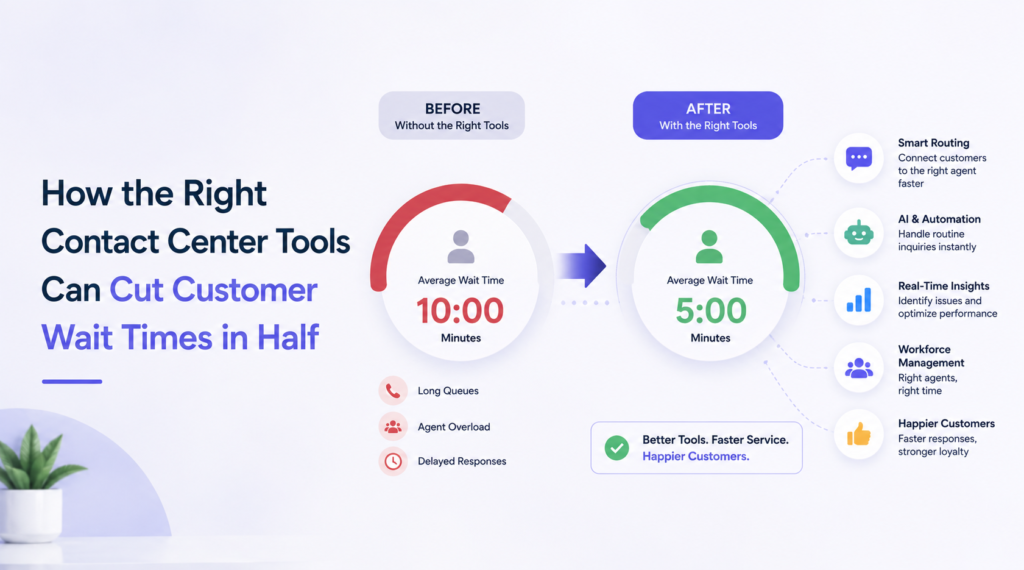
How the Right Contact Center Tools Can Cut Customer Wait Times in Half
Nobody hangs up because they’re angry about the product. They hang up because they’ve been on hold for eleven minutes listening to the same thirty seconds of hold music loop over and over. Wait times are the single biggest driver of customer frustration in support, and most of it comes down to something fixable: the tools behind the scenes.
Businesses that manage to cut their average hold time significantly aren’t necessarily hiring more agents. They’re rethinking their Contact Center Tools: Optimize Customer Service approach from the ground up. Here’s what actually moves the needle, and why.
Why Wait Times Balloon in the First Place
Before fixing anything, it helps to know where the time actually goes. Long queues usually come from three places: too many calls hitting too few agents, calls landing with the wrong agent and needing a transfer, or agents spending too long per call because they’re hunting for information mid-conversation.
Fix the routing and the information problem, and wait times drop even without adding headcount. That’s the part most businesses miss. They assume the fix is hiring, when the fix is usually infrastructure.
Smarter Call Routing Changes Everything
A basic phone tree sends every call into one queue and lets agents pick them up in order. That’s fine at low volume. It falls apart the moment your team has specialists, because now a billing question might sit behind five product questions in the same line, waiting for whoever’s next.
Skills-based routing solves this by matching each call to the agent best equipped to handle it, based on what the caller needs, not just who’s free. A customer with a technical issue gets routed to technical support immediately instead of waiting for a generalist who then transfers them anyway, doubling the wait.
Predictive and AI-Driven Queue Management
Static queues treat every hour the same. Smart queue management doesn’t. It forecasts volume based on historical patterns, time of day, and even external factors like a recent product launch or a service outage, then adjusts staffing or routing rules automatically.
Some platforms go further with AI that predicts wait time in real time and offers callers a choice: stay on hold, or get a callback the moment an agent frees up. That single feature alone removes the psychological weight of waiting, since the customer isn’t stuck listening to a clock they can’t see.
Self-Service That Actually Resolves Things
A shocking number of calls are for things a customer could solve themselves in under a minute, if the option existed. Checking an order status. Resetting a password. Confirming business hours. Every one of these tying up a live agent adds minutes to everyone else’s wait.
Well-built IVR and chatbot systems intercept these requests before they ever reach a queue. Done well, this can pull a third of incoming volume away from live agents, which directly shortens the line for everyone with a genuinely complex issue.
Unified Customer Data at the Point of Contact
Here’s a quiet time-waster nobody talks about enough: agents searching for context. A customer calls, explains their issue, and the agent has to dig through three systems to find their order history, previous tickets, and account status. That search adds minutes to every single call, multiplied across hundreds of calls a day.
When contact center software integrates directly with CRM and order management systems, that information appears the second the call connects. No searching, no “can you repeat your account number.” The conversation starts where it needs to, and average handle time drops as a result.
Omnichannel Handling Instead of Channel Silos
If chat, email, and phone are handled by separate teams using separate systems, customers end up waiting multiple times for the same issue. They message on chat, don’t get an answer fast enough, then call, and the phone agent has zero visibility into that chat thread. Now they’re waiting again, explaining everything from scratch.
Omnichannel platforms merge these into a single queue and a single customer record, so whoever picks up the conversation, whatever channel it started on, already has full context. Wait times shrink because customers aren’t restarting the clock every time they switch channels.
The Infrastructure Underneath It All
None of this works if the underlying phone infrastructure is unreliable. Choppy calls, dropped connections, and lag force agents to ask customers to repeat themselves, which adds time to every interaction. This is usually the point where businesses decide to Replace Legacy Phone Systems, since older PBX setups simply weren’t built for the call volume or flexibility modern support teams need.
Cloud-based Business Phone Systems solve this at the foundation level. Calls route faster, scale instantly during volume spikes, and integrate with the rest of the contact center stack instead of sitting as an isolated piece of hardware in a server closet somewhere.
What “Cutting Wait Times in Half” Actually Looks Like
This isn’t a hypothetical number. A business handling 500 calls a day, with an average wait of six minutes, is losing roughly 50 hours of combined customer time daily. Layer in skills-based routing, a working self-service option, and unified customer data, and that same volume often resolves in three minutes or less, without adding a single new agent.
The compounding effect matters here too. Shorter calls mean agents clear the queue faster, which means the next caller waits less, which means fewer abandoned calls and fewer repeat contacts from frustrated customers calling back to ask why nobody answered the first time.
Getting Started Without Overhauling Everything at Once
You don’t need to replace your entire stack in one sprint. Start with the biggest bottleneck. If calls are landing with the wrong agents, fix routing first. If agents are searching for customer data mid-call, integrate the CRM next. If your infrastructure itself is unreliable, that’s the one to prioritize before anything else, since every other fix builds on top of a stable connection.
Omnicaas works with growing teams to identify exactly where wait times are coming from and builds a stack that addresses the real bottleneck, not just the symptom. Sometimes that’s a phone system upgrade. Sometimes it’s smarter routing. Usually it’s a combination of both.
Cutting wait times in half isn’t about working faster under pressure. It’s about removing the friction that made customers wait in the first place.