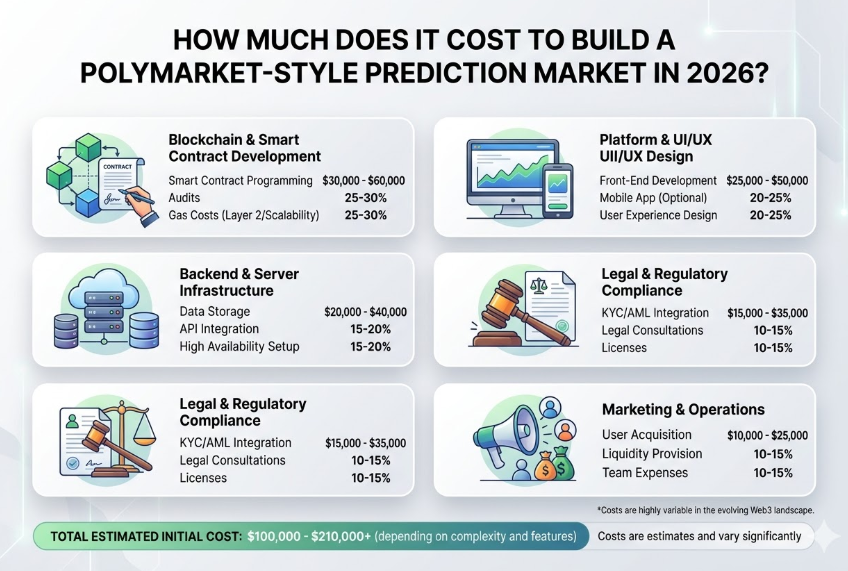
How Much Does It Cost to Build a Polymarket‑Style Prediction Market in 2026
The world of prediction markets is rapidly evolving, and as we step into 2026, entrepreneurs and blockchain enthusiasts are increasingly exploring opportunities in this space. Prediction markets allow individuals to speculate on the outcome of future events, ranging from elections to sports events to financial forecasts. The allure of combining crowd intelligence with financial incentives has made these platforms highly attractive for both investors and tech innovators. If you’re considering entering this booming market, understanding the cost dynamics is crucial. In this article, we delve into everything you need to know about building a prediction market platform similar to Polymarket. Our focus starts with polymarket clone development and extends to the broader aspects of running a successful prediction marketplace.
Understanding Polymarket and Its Success
Polymarket has become a benchmark for decentralized prediction markets. Its appeal lies in a simple yet powerful premise: users can trade on outcomes, and the market itself aggregates collective wisdom to provide probabilistic forecasts. This model combines aspects of financial trading and social prediction, creating a unique ecosystem that incentivizes knowledge and insight. To emulate this success, your platform must replicate its core features while offering unique differentiators that attract users.
From a technical perspective, Polymarket leverages blockchain technology to ensure transparency and security in all transactions. Smart contracts handle bets, outcomes, and payouts without intermediaries. Moreover, the user interface prioritizes ease of use, making it accessible even for individuals unfamiliar with blockchain. When planning polymarket clone development, these elements become foundational pillars of your platform.
Key Features to Include in Your Prediction Market Platform
A prediction market platform is more than just a betting interface. It is a complex ecosystem where user experience, security, and transparency are intertwined. Core features you must integrate include a robust trading engine, real-time market updates, a secure wallet system, and an intuitive user interface. Additionally, features like event creation tools, liquidity pools, and automated market makers enhance user engagement and platform reliability.
Security is paramount. Smart contracts must be audited to prevent exploitation, while data encryption safeguards sensitive user information. Incorporating KYC/AML compliance ensures regulatory adherence, which is especially important in jurisdictions where prediction markets are closely monitored.
Another crucial aspect is scalability. As your platform grows, it must handle increased user activity without lag or downtime. Cloud infrastructure, load balancing, and efficient database management play critical roles in maintaining smooth operations.
Technical Architecture of a Prediction Marketplace Platform
Building a prediction market platform requires a layered architecture. At the core is the blockchain layer, where smart contracts execute trades and store outcomes immutably. Above this, a middleware layer manages API interactions, user authentication, and data processing. Finally, the frontend layer delivers a seamless user experience, integrating charts, notifications, and intuitive navigation.
Incorporating prediction marketplace platform development best practices involves choosing the right blockchain framework, such as Ethereum, Polygon, or Solana, based on your scalability and transaction-cost requirements. Additionally, integrating oracles is essential to accurately feed real-world data into smart contracts. These technical choices directly impact both performance and user trust.
Development Phases and Cost Considerations
The cost to develop a Polymarket-style prediction market varies widely based on features, technology stack, and team composition. Typically, development proceeds in phases:
- Conceptualization and Design: This phase involves market research, UI/UX design, and technical specification. Costs range from $5,000 to $25,000, depending on design complexity.
- Blockchain and Smart Contract Development: The heart of your platform, smart contract coding, testing, and deployment require blockchain expertise. This can cost between $50,000 to $100,000.
- Frontend and Backend Development: Integrating the user interface with the blockchain backend, including features like real-time updates, notifications, and analytics, can cost $40,000 to $80,000.
- Testing and QA: Thorough testing, including smart contract audits, penetration testing, and usability testing, can add $15,000 to $30,000.
- Launch and Maintenance: Post-launch costs include server hosting, ongoing development, updates, and customer support. Expect annual costs around $20,000 to $50,000.
Factors Influencing the Cost to Build Prediction Market Platform
Several variables affect the overall investment required. Feature complexity is a major driver: advanced trading algorithms, AI-powered forecasting, and automated market makers increase development time and cost. Platform scalability also matters; supporting thousands of simultaneous users demands robust infrastructure. Additionally, compliance with regional regulations can involve legal consulting and additional development to implement KYC/AML systems.
Marketing and user acquisition are often underestimated costs. A well-designed platform will not thrive without an active user base. Budgeting for community engagement, partnerships, and promotional campaigns is crucial to ensure your prediction market gains traction.
Choosing Between Custom Development and White-Label Solutions
Businesses entering the prediction market space have two main paths: building from scratch or opting for a white-label solution. Custom development offers complete control and the ability to innovate but comes with higher costs and longer timelines. Conversely, white-label platforms allow faster deployment and lower initial costs but may limit customization options. Evaluating your strategic goals and budget will guide this decision effectively.
Monetization Strategies
Successful prediction markets employ multiple revenue streams. Trading fees, platform commissions, and premium features are common. Additionally, offering liquidity incentives or token-based rewards can attract more participants. Understanding these models early helps in designing both the technical architecture and business plan.
The Future of Prediction Markets
The evolution of blockchain technology, AI, and decentralized finance continues to shape the prediction market landscape. Platforms like Polymarket have set benchmarks, but innovation is key to staying competitive. Integrating real-time analytics, leveraging AI for predictive insights, and expanding into niche verticals can differentiate your platform and increase user engagement.
By 2026, the prediction market ecosystem is expected to see greater adoption in finance, sports, politics, and beyond. Platforms that prioritize security, user experience, and innovation will lead the market.
Conclusion
Launching a Polymarket-style prediction market is both a technically complex and financially significant undertaking. From polymarket clone development to prediction marketplace platform development, each phase requires careful planning, skilled execution, and strategic investment. While costs vary based on feature complexity and scalability, a typical project can range from $5,000 to $30,000 or more. Factoring in operational expenses, compliance, and marketing ensures your platform not only launches successfully but thrives in the competitive landscape.
Investing in a prediction market platform today positions you at the forefront of a growing industry where technology meets collective intelligence. By understanding the development process, budgeting accurately, and innovating continuously, you can create a platform that resonates with users and captures the promise of decentralized forecasting.