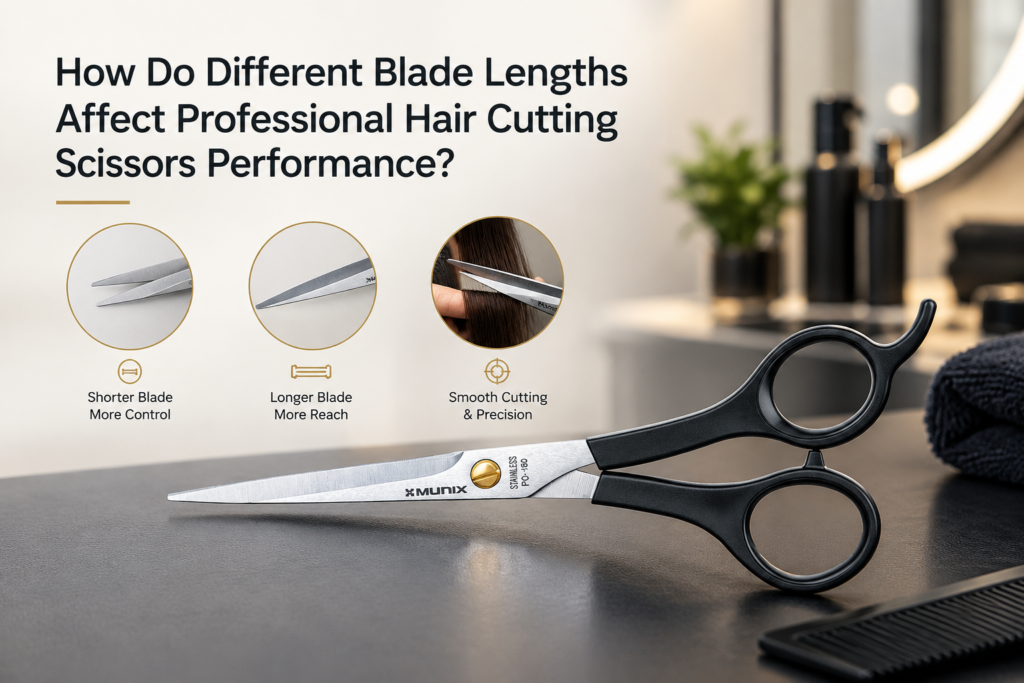
Choosing professional hair cutting scissors involves more than checking blade sharpness or material quality. Blade length also plays an important role in determining cutting accuracy, hand movement, control, and overall working comfort. The right length can help a hairdresser perform specific techniques efficiently, while an unsuitable size may make certain movements difficult or require unnecessary adjustments.
Professional hair cutting scissors are available in different blade lengths to accommodate various cutting methods, hand sizes, and professional requirements. Shorter scissors generally offer greater control for detailed work around the ears, neckline, and fringe. Longer scissors can help cover wider sections of hair with fewer strokes, making them useful for techniques such as scissor-over-comb cutting and some blunt-cutting methods.
For salon professionals, barbering practitioners, and hairdressing students in Ludhiana, understanding these differences can support more informed equipment decisions. The ideal blade length depends on the type of haircuts performed, the stylist’s technique, hand comfort, and the level of precision required.
This guide explains how blade length affects professional hair cutting scissors performance, how different sizes are used, and what to consider before selecting a pair. It also discusses practical maintenance and handling considerations relevant to everyday salon work.
What Is Blade Length in Professional Hair Cutting Scissors?
Blade length refers to the length of the cutting blade, measured from the pivot area toward the tip. Scissor sizes are commonly expressed in inches, although measurement conventions can differ between manufacturers. Some include the entire blade section, while others measure from the pivot to the tip.
Professional hair cutting scissors commonly fall within approximately 5 to 7 inches, although shorter and longer options are also available. The measurement alone does not determine performance because blade shape, handle design, pivot tension, and overall balance also influence how scissors feel and function.
Before comparing sizes, check the manufacturer’s measurement method to ensure that the dimensions are being compared consistently.
How Do Different Blade Lengths Affect Cutting Performance?
1. Shorter Blades for Precision and Detail
Shorter professional hair cutting scissors, often around 5 to 5.5 inches, can provide greater manoeuvrability for detailed cutting tasks.
They are useful when working around curved areas of the head or making small, controlled adjustments. The shorter blade can also make it easier for some stylists to position the cutting edge accurately.
Common applications include:
- Refining fringe and bangs.
- Detailing around the ears.
- Trimming the neckline.
- Making small adjustments to layered hair.
- Performing precise cuts on limited sections.
However, a shorter blade may require more strokes when cutting across wide sections of hair. The stylist must also avoid assuming that a shorter blade automatically provides greater precision; technique and blade sharpness remain important.
2. Medium-Length Blades for Versatile Salon Work
Scissors measuring approximately 5.5 to 6 inches can provide a balance between manoeuvrability and cutting coverage.
This range is often considered by hairdressers who perform a mixture of precision work, general trims, layering, and longer cutting movements. The suitability of a particular size depends on the stylist’s hand dimensions and preferred technique.
Medium-length professional hair cutting scissors may be appropriate for:
- Routine salon haircuts.
- General trimming and shaping.
- Creating layers.
- Cutting medium-length hair.
- Alternating between detail work and broader sections.
For a hairdresser who handles varied appointments throughout the day, a versatile length may reduce the need to switch tools frequently. Nevertheless, comfort should be assessed through actual handling rather than size alone.
3. Longer Blades for Wider Cutting Movements
Longer professional hair cutting scissors, commonly around 6 to 7 inches, can cover more hair during each cutting movement.
They are frequently used for scissor-over-comb techniques, certain blunt cuts, and work involving larger sections. The longer cutting edge can help experienced stylists maintain a continuous line across a section of hair.
Typical applications include:
- Scissor-over-comb barbering.
- Cutting longer or wider sections.
- Creating straight, continuous lines.
- Reducing the number of strokes on suitable sections.
- Performing some traditional barbering techniques.
Longer blades may feel less manageable for intricate detailing, especially for users with smaller hands or limited experience. They can also require more deliberate control because a small change in hand position may affect a wider cutting area.
Does Blade Length Affect Cutting Accuracy?
Yes. Blade length can influence cutting accuracy, but it does not determine accuracy by itself.
Shorter blades can make small adjustments easier because the cutting area is more compact. Longer blades can help maintain a consistent line across broader sections when the stylist has sufficient control and experience.
Accuracy also depends on several other factors:
- Blade sharpness: Dull edges may push or bend hair instead of cutting it cleanly.
- Blade geometry: The edge design influences cutting action and technique suitability.
- Pivot tension: Incorrect tension can affect smooth movement and control.
- Hand position: Stable positioning helps maintain the intended cutting line.
- Hair preparation: Uneven sectioning or inconsistent tension can affect results.
For example, trimming a fringe requires controlled movements and careful positioning, whereas creating a straight line across long hair may benefit from a longer blade and a consistent cutting technique.
The most appropriate length is therefore the one that supports the intended task without compromising control.
How Should You Choose Blade Length for Your Hair Cutting Technique?
For Layering and Texturising
Layering involves changing hair length across different sections, so manoeuvrability and accurate positioning are important. A medium-length scissor may suit general layering, while shorter scissors can help with detailed adjustments.
Texturising is a separate technique that may require specialised texturising or thinning scissors. Standard cutting scissors should not automatically be treated as interchangeable with these tools.
For Blunt Cuts and Straight Lines
Longer blades may help experienced stylists create continuous lines across wider sections. However, sectioning, body position, hair tension, and cutting angle remain essential to achieving an even result.
A longer blade will not correct poor sectioning or inconsistent technique.
For Barbering and Scissor-Over-Comb
Barbers often use longer scissors when cutting hair that extends over a comb. The additional blade length can help cover a wider area with fewer movements.
The scissors should still feel stable when opening and closing repeatedly. If the blade feels difficult to control, a shorter size may be more suitable.
For Beginners and Hairdressing Students
Students should prioritise comfortable handling, safe finger positioning, and controlled movement rather than choosing a size based on professional appearance.
A medium-length pair may provide a useful starting point, but beginners should follow their instructor’s guidance and test suitable sizes before making a decision.
What Should Buyers in Ludhiana Consider Before Choosing Scissors?
When evaluating professional hair cutting scissors in Ludhiana, consider the type of salon work, barbering services, and training requirements involved.
Use the following checklist:
- Measure hand comfort: Check whether the finger rings allow a relaxed, controlled grip.
- Match the blade to the technique: Consider whether most work involves detailing, general cutting, or scissor-over-comb.
- Check the cutting action: The blades should move smoothly without excessive looseness or resistance.
- Assess balance: The scissors should feel manageable during repeated opening and closing.
- Confirm the measurement: Review the manufacturer’s stated blade or scissor length.
- Consider maintenance: Check whether suitable sharpening and servicing are available.
- Test safely: If possible, handle the scissors under appropriate supervision before purchasing.
People researching Munix KGOC or comparing different professional hair cutting scissors should apply the same practical criteria. The decision should be based on specifications, handling comfort, intended use, and maintenance requirements rather than brand recognition alone.
How Can You Maintain Professional Hair Cutting Scissors?
Correct maintenance helps preserve cutting performance regardless of blade length.
Follow these basic practices:
- Clean the blades after use according to the manufacturer’s instructions.
- Dry them thoroughly to reduce the risk of corrosion.
- Apply suitable scissor lubricant when recommended.
- Check pivot tension and blade alignment regularly.
- Store scissors in a protective case when not in use.
- Arrange professional sharpening when the cutting action deteriorates.
Avoid using hair cutting scissors on paper, packaging, or other materials because these activities can affect the cutting edge. Do not attempt to sharpen precision scissors with household sharpening tools.
Longer scissors may cover more hair per movement, but they still require consistent maintenance and correct handling.
Conclusion
Blade length influences how professional hair cutting scissors perform during detailed trimming, general salon work, blunt cutting, and barbering. Shorter blades support manoeuvrability, medium lengths offer versatility, and longer blades can help cover wider sections efficiently when used with appropriate technique.
There is no single length that suits every stylist or cutting method. For salon professionals and learners in Ludhiana, the practical approach is to evaluate hand comfort, intended use, blade design, and maintenance needs together.
Before selecting professional hair cutting scissors, compare the available measurements and assess how each size feels during controlled handling. Understanding these factors can help you make a more informed decision when evaluating options, including those available from Munix KGOC.
FAQs
1. What blade length is suitable for professional hair cutting scissors?
Blade lengths around 5.5 to 6 inches can provide versatility for many salon tasks. However, the suitable size depends on hand comfort, cutting technique, and the type of work performed.
2. Are longer hair cutting scissors easier to use?
Not necessarily. Longer scissors can cover wider sections and assist with scissor-over-comb techniques, but they may be harder to manoeuvre for detailed work. Experience, balance, and hand comfort affect usability.
3. Do shorter scissors provide greater cutting precision?
Shorter scissors can make detailed movements easier, particularly around the ears, neckline, and fringe. However, accuracy also depends on sharpness, blade design, positioning, and the stylist’s technique.
4. Which professional hair cutting scissors should beginners consider?
Beginners should consider a comfortable, manageable size that supports controlled movement and their training requirements. Testing different sizes under supervision is more useful than choosing based on length alone.
5. Does blade length affect the quality of a haircut?
Blade length can influence control, cutting coverage, and working efficiency. However, haircut quality also depends on technique, sectioning, blade condition, and the stylist’s understanding of the intended result.