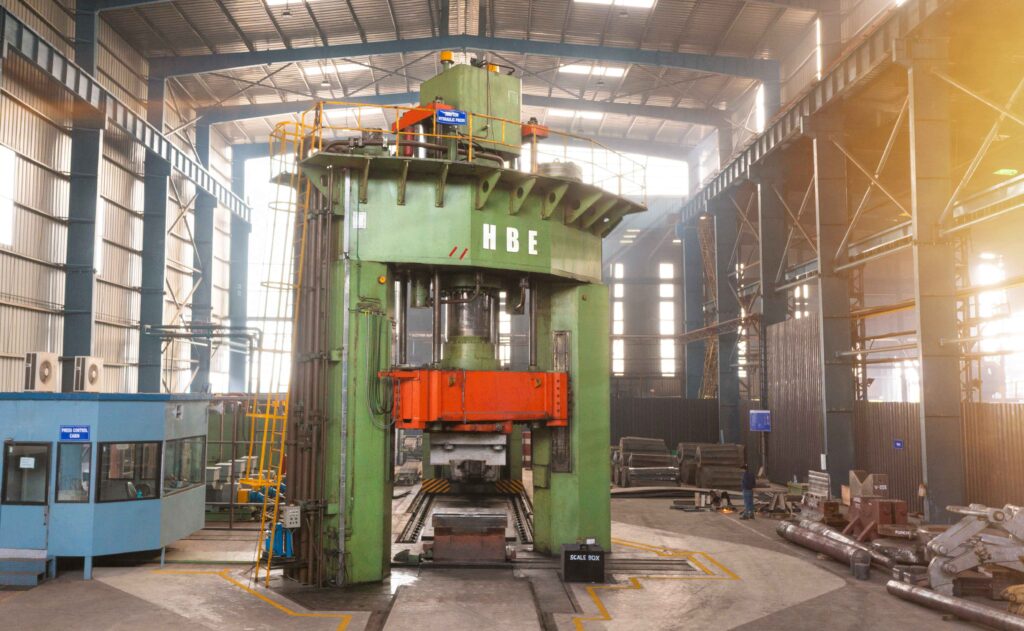
closed die forging supplier in india
Industrial manufacturers face a common challenge: finding components that meet demanding engineering specifications without creating unnecessary complexity in production and procurement. Dimensional inconsistencies, unsuitable material selection, excessive machining, and unreliable supply schedules can affect manufacturing efficiency and increase operational costs. Selecting the right forging partner helps businesses address these challenges while maintaining product quality and production continuity.
Closed-die forging offers an effective manufacturing option for components that require defined shapes, repeatable production, and suitable mechanical properties. The process uses shaped dies to form heated metal under controlled pressure, making it useful for selected automotive, machinery, and industrial engineering applications.
Goodluck India Limited, through GoodLuck Engineering Co., provides forging and related manufacturing capabilities for industrial customers. Businesses searching for a dependable closed die forging supplier in india can explore the company’s capabilities in forging, machining, heat treatment, and quality verification to assess whether they match their project requirements.
Solving Manufacturing Challenges Through Forging
Manufacturing problems often begin when a component’s production method does not align with its design or intended use. A part with complex geometry may require extensive machining if it is produced entirely from solid stock. In other cases, inconsistent material properties or inadequate process control can make it difficult to achieve repeatable results.
Closed-die forging addresses certain challenges by shaping metal between dies designed around the component’s geometry. When tooling, temperature, material flow, and deformation are properly controlled, the process can produce repeatable shapes and favorable grain-flow characteristics.
The final result depends on the material grade, component design, forging conditions, and subsequent operations. Trimming, heat treatment, machining, and inspection may be required to achieve the finished dimensions and mechanical properties.
For procurement teams, the key is to evaluate the entire manufacturing route rather than focusing only on the forging stage. A suitable supplier should understand the component’s functional requirements and help establish the production steps needed to meet the agreed specification.
Goodluck India supports industrial enquiries involving forged products and related manufacturing processes, allowing buyers to discuss their requirements with a view to technical suitability and production feasibility.
Goodluck India: Connecting Engineering Requirements with Production Capabilities
A manufacturing partner must be able to understand drawings, evaluate materials, plan production, and maintain appropriate quality controls. These capabilities are particularly important when customers require customized components rather than standard catalogue products.
Goodluck India Limited operates its forging division through GoodLuck Engineering Co. Its published capabilities include open-die and closed-die forging, heat treatment, machining, and inspection services. The product portfolio includes flanges, shafts, forged bars, stub ends, collars, and other forged components.
This range provides industrial buyers with opportunities to discuss related product requirements with one manufacturing organization. The appropriate production method depends on factors such as component weight, geometry, material, order quantity, tolerances, and applicable standards.
When approaching a closed die forging supplier in india, businesses should provide detailed technical information at the beginning of the enquiry. Engineering drawings, material grades, annual consumption, critical dimensions, finishing requirements, and inspection criteria help the supplier assess the project more effectively.
Clear communication at this stage can reduce uncertainty, support realistic production planning, and help identify potential manufacturing issues before tooling or production begins.
How Closed-Die Forging Supports Component Consistency
Repeatability is essential in manufacturing environments where components must fit into assemblies with limited dimensional variation. Even small differences in critical features can create problems during installation, machining, or final assembly.
Closed-die forging can support repeatable production when the dies are appropriately designed and maintained and the process is controlled. The die cavity determines the intended shape, while process parameters influence material flow and the resulting component characteristics.
However, forging does not automatically eliminate every dimensional variation or remove the need for finishing. Forged parts may require machining to achieve precise bores, threads, mating surfaces, or other critical features. Inspection requirements should therefore be established according to the component drawing and its intended application.
For buyers, it is useful to identify which dimensions can be achieved during forging and which require subsequent machining. This distinction helps establish realistic tolerances, reduce unnecessary operations, and support accurate cost estimation.
Goodluck India’s forging and machining capabilities can be evaluated by customers seeking a coordinated manufacturing route for suitable forged components. The technical enquiry should clearly identify the required finished condition so that production planning reflects the complete scope of work.
Automotive Forging Components Supplier for Demanding Applications
Automotive manufacturing involves components that may experience repeated loading, vibration, impact, and changing temperatures. The production method must be appropriate for the component’s function and the mechanical properties specified by the designer.
An experienced automotive forging components supplier considers the relationship between component geometry, material selection, forging conditions, heat treatment, machining, and inspection. These factors influence whether a forged component can meet the requirements established by the automotive manufacturer or OEM.
Closed-die forging may be appropriate for selected components requiring defined shapes and repeatable production. Dedicated tooling can support consistent manufacturing for suitable production volumes, while controlled finishing operations help achieve the specified dimensions.
Automotive procurement teams should confirm material standards, mechanical property requirements, traceability expectations, dimensional tolerances, and any applicable customer-specific quality procedures. These requirements should be agreed upon before production begins.
Goodluck India provides forging capabilities that customers can evaluate for automotive and other industrial requirements. Buyers can submit component drawings, material specifications, expected quantities, and inspection plans to discuss manufacturing feasibility.
A well-defined production plan helps align the supplier’s output with the customer’s assembly process and purchasing schedule, supporting a more dependable manufacturing relationship.
Flanges for Industrial Piping and Equipment
Flanges are important connection components in piping systems, process plants, and industrial equipment. They allow compatible pipes, valves, fittings, and other equipment to be joined in configurations determined by the system design.
Selecting a suitable flange requires attention to material grade, nominal size, pressure class, facing type, dimensional standard, temperature, and service conditions. The required configuration should be confirmed against the applicable engineering specification rather than selected on appearance alone.
Businesses searching for a flanges manufacturer and exporter india should assess manufacturing capabilities, dimensional control, material verification, finishing operations, and documentation. These factors help determine whether the supplied product is suitable for the intended installation.
Goodluck India’s forging portfolio includes flange products for industrial applications. Depending on the enquiry, customers can discuss flange types, dimensions, materials, machining requirements, and applicable standards with the company.
Flanges may require precision machining after forging to achieve the specified facing, bore, thickness, and connection dimensions. Quality checks should verify the features that affect assembly and service performance.
For international procurement, packaging, product identification, traceability, and export documentation are also important. Buyers should communicate these requirements early to help ensure that the finished order is prepared for its destination and intended use.
Stubendscollars for Piping Connections
Piping projects frequently require specialized components that must match the system’s geometry and operating conditions. Stub ends and collars may be included in industrial piping and forged-component enquiries, but buyers should identify the precise product because the terms can refer to different configurations.
In a typical lap-joint arrangement, a stub end is attached to the pipe and used with a compatible loose backing flange. The backing flange can rotate for alignment during installation, where the system design and applicable standards permit this arrangement.
The suitability of stubendscollars depends on the component dimensions, material compatibility, wall thickness, connection configuration, and operating conditions. Pressure, temperature, corrosion exposure, and relevant piping standards must also be considered.
Goodluck India’s forging product range includes stub ends, collars, flanges, and related products. Customers can submit drawings or technical specifications to clarify the required component and determine the appropriate manufacturing route.
For procurement professionals, accurate product descriptions are essential. A quotation request should identify the exact item, material grade, dimensions, applicable standard, required quantity, and inspection documentation. This helps reduce misunderstandings and makes supplier evaluation more straightforward.
Forged Bars for Further Machining and Engineering
Forged bars are used as starting material for manufacturing shafts, machine parts, and other engineered components. Their suitability depends on the required material properties, dimensions, manufacturing route, and the conditions under which the finished component will operate.
A forged bar’s specification may include the material grade, diameter or cross-section, length, heat-treatment condition, mechanical properties, dimensional tolerances, and testing requirements. These details help ensure that the supplied material is appropriate for subsequent machining and assembly.
Goodluck Engineering Co. lists forged bars among its product offerings. Buyers can discuss their required sizes, materials, supply conditions, and documentation according to the intended application.
Forging can help develop useful material characteristics, but final performance depends on the alloy, processing conditions, heat treatment, and quality verification. For this reason, customers should avoid choosing material solely on the basis of size or price.
Where bars will be machined into critical components, procurement teams should also consider machining allowances and the finished part’s dimensional requirements. Clear coordination between the material supplier and the machining operation can help reduce waste and improve production planning.
Quality Assurance and Process Verification
Quality assurance connects manufacturing activity with the requirements established by the customer. A forged component should be inspected against its agreed specification before acceptance, with the testing plan determined by the product and its intended use.
Depending on the application, quality checks may include chemical composition analysis, mechanical testing, hardness measurement, dimensional inspection, positive material identification, ultrasonic testing, and other suitable examinations.
Goodluck Engineering Co. reports testing and inspection capabilities supporting its forging operations. The specific checks applicable to an order should be confirmed during technical discussions rather than assumed to apply identically to every product.
Customers should define acceptance criteria before production begins. This may include required certificates, test reports, traceability information, dimensional records, and any customer-specific inspection procedures.
An agreed quality plan helps reduce disputes during final inspection and provides a clear basis for evaluating whether the delivered product meets the contract requirements. It also helps suppliers and customers address nonconformities through a defined process.
What Buyers Should Confirm Before Placing an Order
Choosing a forging supplier involves more than comparing quotations. Buyers should assess whether the proposed manufacturing process is appropriate for the component and whether the supplier can meet the technical, quality, and delivery requirements.
Before confirming an order, provide the supplier with a complete drawing, material specification, dimensions, tolerances, order quantity, expected delivery date, and applicable standards. Specify any required heat treatment, machining, testing, marking, packaging, and documentation.
It is also useful to clarify whether the quotation covers raw material, tooling, forging, finishing operations, inspection, and packaging. Understanding the scope prevents unexpected differences between supplier quotations.
Goodluck India encourages industrial customers to discuss project-specific requirements so that manufacturing feasibility can be assessed against the available capabilities. Whether the enquiry concerns flanges, forged bars, stubendscollars, or automotive components, a complete technical brief supports a more effective evaluation.
Contact Goodluck India for Forging Enquiries
Goodluck India Limited serves industrial customers seeking forged products and customized engineering solutions through its manufacturing capabilities.
Company: Goodluck India Limited
Division: GoodLuck Engineering Co.
Address: Good Luck House, II F, 166-167, Nehru Nagar 2, Ambedkar Road, Ghaziabad – 201001, Uttar Pradesh, India
Phone: +91-0120-4196600 / 4196700
Email: goodluck@goodluckindia.com
For a quotation, buyers should share drawings, material grades, dimensions, quantities, finishing requirements, inspection criteria, and delivery expectations. This information helps establish the scope of work and supports a more accurate technical and commercial assessment.
Conclusion
Reliable industrial manufacturing begins with choosing a process that matches the component’s design and intended use. Closed-die forging can provide repeatable shapes and suitable mechanical characteristics for selected applications when supported by sound tooling design, controlled processing, appropriate finishing, and effective inspection.
Goodluck India Limited, through GoodLuck Engineering Co., offers forging capabilities that industrial buyers can evaluate for automotive, piping, machinery, and other engineering requirements. From flanges and forged bars to stubendscollars, each product should be specified according to its dimensions, material, and operating conditions.
Businesses seeking a dependable closed die forging supplier in india can contact Goodluck India to discuss their requirements and assess a suitable manufacturing route. Clear specifications and open technical communication help establish a productive supplier relationship built around quality, consistency, and long-term industrial needs.
Frequently Asked Questions
What does a closed-die forging supplier do?
A closed-die forging supplier forms metal between shaped dies to manufacture components with defined geometries. Depending on the product, additional services may include heat treatment, machining, finishing, and inspection.
What should I look for in a flanges manufacturer and exporter in India?
Review the supplier’s material options, flange types, dimensional capabilities, machining, quality verification, applicable standards, packaging, and export documentation. Confirm the product specification before placing an order.
How can I evaluate an automotive forging components supplier?
Assess the supplier’s ability to meet component drawings, material requirements, dimensional tolerances, testing criteria, production volumes, and delivery schedules. Automotive-specific requirements should be communicated at the enquiry stage.
What information is required to order stubendscollars?
Provide the exact product type, drawing, material grade, dimensions, piping configuration, applicable standard, quantity, and service conditions. This helps the supplier evaluate the requested component accurately.
What are forged bars used for?
Forged bars are commonly used as starting material for machining shafts, mechanical components, and other engineered products. The correct specification depends on material grade, dimensions, mechanical properties, and intended application.