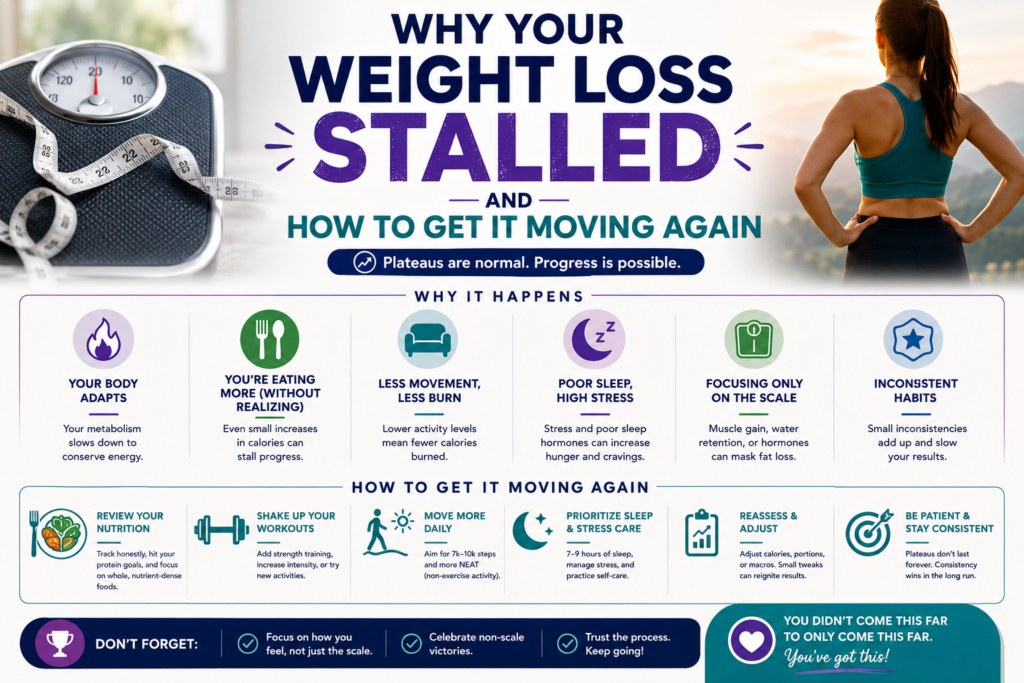
Why Your Weight Loss Stalled — And How to Get It Moving Again
One week you’re down two pounds. The next week, nothing. Then a week later, the scale actually creeps up half a pound even though you haven’t changed a thing. If this sounds familiar, you’re not doing anything wrong. You’ve hit the point where your body stops cooperating with the plan that used to work.
This is one of the most common and most misunderstood parts of any weight loss journey. Understanding why it happens is the difference between giving up in frustration and pushing through to your actual goal.
Your Body Isn’t Broken, It’s Adapting
The human body is remarkably good at conserving energy, and that’s precisely the problem when you’re trying to lose weight. Every pound you shed lowers the number of calories your body needs to keep running. Fewer calories needed means the deficit you created weeks ago has shrunk or disappeared entirely, even though your eating habits haven’t changed.
At the same time, your hormones start pulling against you. Leptin, the hormone that tells your brain you’re full, drops as body fat decreases. Ghrelin, the hunger hormone, rises. You end up hungrier while eating less, which is exhausting to manage through willpower alone.
None of this means your metabolism is permanently damaged. It means your current approach was calibrated for a body that no longer exists, and it needs updating.
The Calorie Math Has Changed
Here’s something people rarely account for. If you started your plan needing 1800 calories a day to lose weight, and you’ve since dropped 10kg, your maintenance calories have likely fallen too. Eating the same 1800 calories that once created a deficit might now be close to your new maintenance level.
This is why weight loss that once felt automatic starts to feel like pushing a boulder uphill. The fix isn’t always to eat drastically less. Sometimes it means adjusting by a modest 100 to 150 calories, reassessing activity levels, or simply being more precise about portions that have quietly grown over time.
Water Retention Is Hiding Your Progress
Not every stall is a true stall. Muscle repair after exercise, hormonal fluctuations, higher sodium intake, or even stress can cause your body to hold onto extra water for days at a time. That water sits on top of actual fat loss and hides it from the scale.
This is why tracking body measurements, progress photos, or how your clothes fit gives a more honest picture than daily weigh ins. A stalled scale doesn’t always mean stalled fat loss. Sometimes it just means the water hasn’t cleared yet.
Your Activity Level May Have Quietly Dropped
As people lose weight, something interesting happens. Daily movement often decreases without anyone noticing. You might sit more at your desk, fidget less, or take the stairs a little slower than you did a few months ago. This is called non exercise activity thermogenesis, and it can account for a surprisingly large chunk of daily calorie burn.
A structured workout three times a week doesn’t cancel out an otherwise sedentary lifestyle. Building in more incidental movement, parking further away, taking calls standing up, walking during lunch, restores some of that lost calorie burn without adding another gym session to your week.
Sleep Deprivation Undermines Everything Else
It’s tempting to treat sleep as a lifestyle bonus rather than a core part of weight management, but the science says otherwise. Poor sleep raises cortisol, disrupts blood sugar regulation, and increases cravings for high calorie foods the following day. Even a well planned diet struggles against a body that’s running on five hours of broken sleep.
Prioritising seven to nine hours most nights isn’t indulgent. It’s one of the most effective, and most overlooked, tools for getting a stalled plan moving again.
When Lifestyle Adjustments Aren’t Enough
Sometimes the plateau isn’t about small tweaks. Genuine metabolic resistance, insulin sensitivity issues, or hormonal imbalances can make weight loss feel impossible no matter how carefully someone eats or trains. In these situations, understanding how to break a weight loss plateau from both a medical and lifestyle perspective becomes essential rather than optional.
For some patients, Daily Weight Loss Tablets provide the appetite regulation needed to stick to a sustainable calorie target without constant hunger working against them. Others find that Mounjaro Weight Loss Injections address the underlying hormonal signals more directly, helping restart progress where diet changes alone haven’t been enough. Neither option replaces good habits, but both can give the body the support it needs to respond again.
Get a Plan Built Around Your Body, Not a Generic One
Every plateau has a cause, and that cause is rarely identical from one person to the next. What worked for a friend or an online influencer might do nothing for you, simply because your hormones, activity levels, and history with dieting are different.
This is where working with professionals pays off. Weight Medics takes a personalised approach, looking at bloodwork, current habits, and medical history before recommending next steps, rather than offering a one size fits all fix. That kind of targeted assessment often uncovers exactly why progress stopped, and what needs to change to get it going again.
Moving Forward
A stalled scale is frustrating, but it’s rarely permanent and almost never a sign that you’ve failed. Your body has simply adjusted to your current routine, and it’s asking for something new. Recalculate your calorie needs, watch for hidden drops in daily activity, protect your sleep, and don’t hesitate to bring in professional support if the basics stop working.
Progress isn’t always visible week to week. Sometimes it’s happening quietly, just waiting for the right adjustment to show up on the scale.