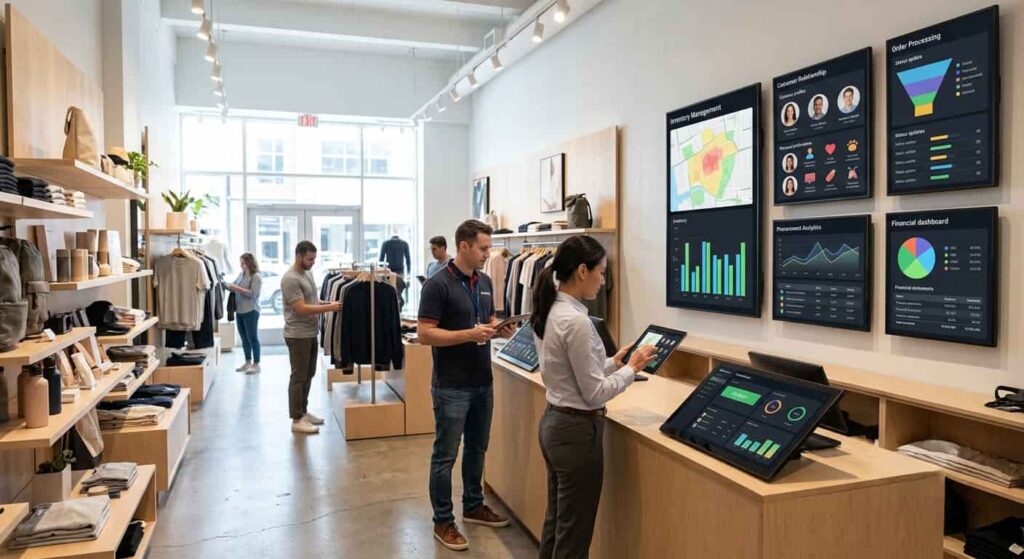
ERP software for retail industry operations has become the backbone of how successful retailers manage everything from inventory to customer experience in an environment that requires speed, accuracy, and seamless coordination across every sales channel. If you run a retail business and still manage inventory in one system, process orders in another and track financials in a third, you already know what that fragmentation costs you in daily operational friction and missed business opportunities.
The retail landscape has changed tremendously in the last 10 years. Customers shop in stores, online, on mobile apps and through third-party marketplaces, frequently changing channels during a single purchase journey. They expect accurate stock information before they arrive at the store. They expect the store associate that assists them to see their online order history. They want the same prices and promotions everywhere at the same time. It is not only difficult to meet these expectations with disjointed systems. There is no way to do this operationally at any meaningful scale.
Retailers operating without integrated systems often suffer from inventory variances between brick-and-mortar and online channels, stockouts that result in lost sales and customer dissatisfaction, overstock situations that tie up capital and result in expensive markdowns, delays in order fulfillment due to a lack of coordination between purchasing and logistics, and financial reporting that can’t keep up with real-time operational data needed to make sound management decisions.
Retailers are investing in ERP solutions because the costs of running on stand-alone systems, both operational and financial, are far greater than the cost of implementation, and that gap widens with every year as transaction volumes grow. The right ERP software for retail industry environments connects all operational functions into one integrated platform, giving every team member the information they need to serve customers well and manage costs effectively.
What Is Retail ERP Software?
Retail ERP software is a complete business management system that has been developed to address the operational needs of businesses in the retail sector. The system consolidates inventory management, point-of-sale processing, order management, purchasing, customer data, financial accounting, and business reporting into a single system that shares data in real-time across all functions.
The retail ERP definition is more than the general ERP definition because retail operations have specific needs that general-purpose ERP systems do not fit well without a lot of customization. A generic ERP system will handle inventory as a warehouse management function. Retail ERP can manage inventory across several stores, distribution centers, and online fulfillment locations simultaneously, with real-time synchronization between all locations. An ERP of any kind processes sales orders. Retail ERP integrates with point of sale systems, ecommerce platforms and marketplace channels to capture all transactions no matter where they occur.
Retail ERP is different, both structurally and functionally, from generic ERP systems. Differences in structure include pre-built connectors to retail-specific systems like POS terminals, e-commerce platforms and loyalty programs that generic ERP requires custom development to establish. Functionality differences include retail-specific capabilities such as season and style-based inventory management, markdown and promotion management, retail-specific financial metrics such as same-store sales and sell-through rates, and omnichannel order orchestration that automatically routes online orders to the nearest fulfillment point.
Key Features of ERP Software for Retail
The features that distinguish effective ERP software for retail industry deployment from generic alternatives are the ones that reflect how retail operations actually work.
Inventory Management
Inventory management in retail ERP is very complex and generic inventory tools do not have this complexity. It tracks each SKU at every site in real time, whether that’s a flagship, a regional distribution center, a pop-up location or an online fulfillment warehouse. Inventory levels at all relevant locations are updated simultaneously for every sale, return, transfer and purchase receipt.
Retail ERP inventory management also deals with the retail specific inventory issues that generic systems treat as exceptions. Seasonal inventory planning allocates buying budgets among product categories based on historical performance and forecasts of future demand. Replenishment automation creates purchase orders when stock at store level falls below pre-set levels, with no need for manual stock checks. Inventory transfers between locations optimize the stock distribution based on where sell-through rates are strongest. These capabilities together prevent stockouts and overstock situations that cost retailers revenue and margin respectively.
Point of Sale Integration
Point of sale integration links the transaction data from every selling point directly to the ERP in real time. When a customer buys something at any of the store terminals, the sale immediately updates inventory levels, records the revenue in the financial accounts, captures customer transaction data and applies any applicable loyalty program points without any manual synchronization step.
ERP software for retail industry environments that aggregates POS data in real-time provides store managers and operations leaders with a real-time view of sales performance during the trading day versus a batch summary at the end of the day. They find out what products are moving and which ones are not. They can see which promotions are driving transactions and which aren’t lifting. And they make replenishment, staffing, and promotional decisions on what’s happening now, not what happened yesterday.
Order Processing
Retail ERP order processing manages each order from every channel in one integrated workflow. All online orders, phone orders, in-store special orders and marketplace orders are processed in the same order management system that allocates inventory, assigns fulfillment locations and tracks through delivery confirmation.
Unified order processing allows the omnichannel fulfillment capabilities that today’s retail customers expect. Orders placed online for store pickup are automatically routed to the nearest location with available stock. The ship from store orders are used to allocate online demand to in-store inventory when the distribution center stock is depleted. The ERP system now makes these routing decisions based on real-time inventory and fulfillment capacity, instead of having to manually manage each order.
Procurement Management
Procurement management in ERP software for retail industry operations links buying decisions with sales performance and inventory position data. The system automatically generates purchase requisitions when stock levels reach certain thresholds. Demand forecasts, current inventory position and supplier lead times are all seen in one interface by buyers before they approve purchase orders that flow to suppliers as structured purchase orders.
Procurement management also helps to support the sophistication of vendor relationships that retail businesses deal with. The procurement module includes multiple suppliers for the same product category, seasonal buying schedules, import logistics timelines, and vendor compliance requirements. Buyers spend time on negotiation and supplier strategy, not manual stock monitoring and order creation.
Customer Relationship Management
In retail ERP, CRM functionality links customer purchase history, loyalty program participation and service interaction records to operational and financial data that supports better customer management decisions. Sales associates who can see a customer’s full purchase history before they approach them can provide better help. Marketing teams who can segment customers by their purchase behaviour are better able to focus promotions.
CRM integration is particularly beneficial for ERP software in retail industry environments because retail customer relationships generate large amounts of behavioral data that, when leveraged properly, drive repeat purchase frequency and basket size. When customers are known and personally served they come back more often and spend more per visit than those on the receiving end of generic service interactions.
Financial Management
Retail ERP financial management addresses retail-specific accounting requirements including the recognition of revenue from multiple locations, the calculation of the cost of goods sold by product category, the analysis of margins by store and channel, the tracking of promotional costs and accounting for shrinkage. It automatically posts all sales transactions, inventory movements and supplier payments to the general ledger with the proper coding to accounts.
ERP software that is capable of financial reporting specific to retail includes same-store sales comparisons to isolate organic growth as opposed to growth from expansion, channel profitability analysis to compare margin contribution by sales channel, and product category margin reporting to identify where gross margin is strongest and where it needs management attention.
Business Intelligence and Reporting
Business intelligence and reporting ERP software for retail deployment The operational data from all retail functions is transformed into the strategic insight that drives better merchandising, pricing, staffing and capital allocation decisions. Real-time sales dashboards simultaneously show performance against plan for each location and category.
ERP retail analytics capabilities include: sell-through rate tracking by product and season; inventory turn analysis by category and location; promotional effectiveness measurement; customer cohort analysis by purchase frequency and basket value; and supplier performance tracking by on-time delivery rate and fill rate. These analytics require the integrated data foundation that can only be provided by ERP software for retail industry environments.
Benefits of ERP for Retail Businesses
The operational improvements that retail ERP delivers produce measurable outcomes across every function that determines retail performance.
Real-time inventory visibility provides every team member who needs inventory data with a complete and up-to-date view, whether they’re on-site or off. It takes a store associate seconds to tell a customer if another location has stock. Buyers can view stock levels for the whole system before placing an order for replenishment. Customer service representatives have current inventory data so they can give accurate delivery estimates.
Integrated retail ERP increases customer satisfaction through consistent and accurate service. Working from integrated data means your team is providing customers with accurate stock information, consistent pricing across channels, seamless omnichannel experiences and faster resolution of service issues.
Automated order routing, real-time inventory allocation and integrated fulfillment workflows shorten the time between order placement and delivery, accelerating order fulfillment. ERP software for retail industry environments removes the manual ping-pong between order management, inventory and logistics that hinders fulfillment in siloed systems.
Better financial control is achieved when every transaction is automatically posted to the general ledger and financial reporting reflects current trading performance rather than yesterday’s batch upload. The retail manager uses accurate and timely financial data to make better decisions about margins and pricing.
Omnichannel retail management comes to life when ERP software for retail industry operations manages inventory, orders and customer data across every channel from one platform. Consistency across channels is increased by enforcing consistent data by the system and not relying on manual coordination between separate channel management tools.
How to Choose the Right Retail ERP
Selecting ERP software for retail industry operations requires evaluating several factors beyond the feature checklist.
Scalability The platform’s ability to support your store count and transaction volume today and as you grow over the next three to five years. Test retail ERP that handles ten locations for performance at fifty locations before you sign up to a platform your growth will outpace.
Cloud versus on-premise deployment impacts total cost, implementation time frame and IT management burden on your business. Cloud-based retail ERP removes the need for hardware investment and IT maintenance inherent with on-premise deployment, and upgrades become automatic rather than disruptive projects. The majority of growing retailers prefer cloud deployment due to its lower upfront costs and more operational flexibility.
Integration capabilities determine how well your retail ERP integrates with your existing technology investments including your e-commerce platform, your loyalty program, your payment processing partners and your third-party marketplace channels. Make sure the specific integrations you need for your current technology stack are available before committing to any platform.
The ease of implementation affects how quickly your business realizes value from the investment. Inquire with vendors about the typical implementation time frames for companies of your size and complexity, the resources you will be required to allocate from your team during implementation, and the approach to data migration for historical transaction and inventory data.
The quality of vendor support will dictate how successful your implementation will be and how fast issues are resolved post go-live. Request references for retailers of similar size and complexity. Consider expectations for response time and retail-specific support expertise versus general technical support.
Common Retail ERP Implementation Challenges
Understanding the challenges that retail ERP implementations commonly encounter helps your business prepare for them rather than discover them mid-project.
The first major challenge is data migration, as retail businesses have large amounts of historical transaction data, product catalog records and customer information which must be transferred accurately to the new system. Poor data migration leads to inaccurate inventory valuations, incomplete customer histories, and financial reporting discrepancies that erode trust in the new system from day one.
Training for an entire retail workforce, including store associates, buyers, store managers, and finance professionals requires training programs specific to the role, focusing on the specific system interactions performed by the role. Generic platform training that covers every feature without role context leads to poor adoption rates and inconsistent data quality.
Careful technical planning for system integration with existing technology investments including POS hardware, e-commerce platforms and loyalty programs needs to be done before implementation can begin. Integration requirements found during the pre-implementation planning phase are less disruptive and less expensive to correct than integration problems found after go live.
Change management is about the people side of moving from current processes and systems to new ways of working. Retail staff who understand why the new system makes them better able to serve customers and do their jobs adopt it more quickly and use it more consistently than staff who are simply handed the system without adequate context as to why the change is taking place.
Conclusion
ERP software for retail industry companies isn’t a technology upgrade. It’s the operational foundation that defines whether a retail business can reliably support customers from all channels, profitably manage inventory, efficiently fulfill orders, and make data-driven decisions that allow it to maintain a competitive edge in a marketplace of ever-increasing customer expectations and competitive intensity.
Retailers lacking an ERP solution cannot match the integrated operational visibility, omnichannel capability and financial control provided by the right ERP solution. The hidden toll of inventory inaccuracies, fulfillment failures and financial reporting delays continue to be paid by retail operations that run on disconnected systems, compounded with every year of growth.
Ready to explore your options? Start by looking at the top ERP software for retail industry platforms that offer the specific features your retail model needs, including omnichannel order management, real-time POS integration and retail-specific financial reporting designed for the way retail businesses actually function.
If you’re a retailer seeking a fully integrated ERP platform that combines inventory, POS, procurement, CRM, finance, and business intelligence into a single scalable system, with implementation support that’s built for retail businesses on the rise, Intersoft ERP is the end-to-end retail management solution to support your operations from your current store count through every stage of future retail growth.