Yellow and Green Bold Geometric Business Agency Facebook Post (10)
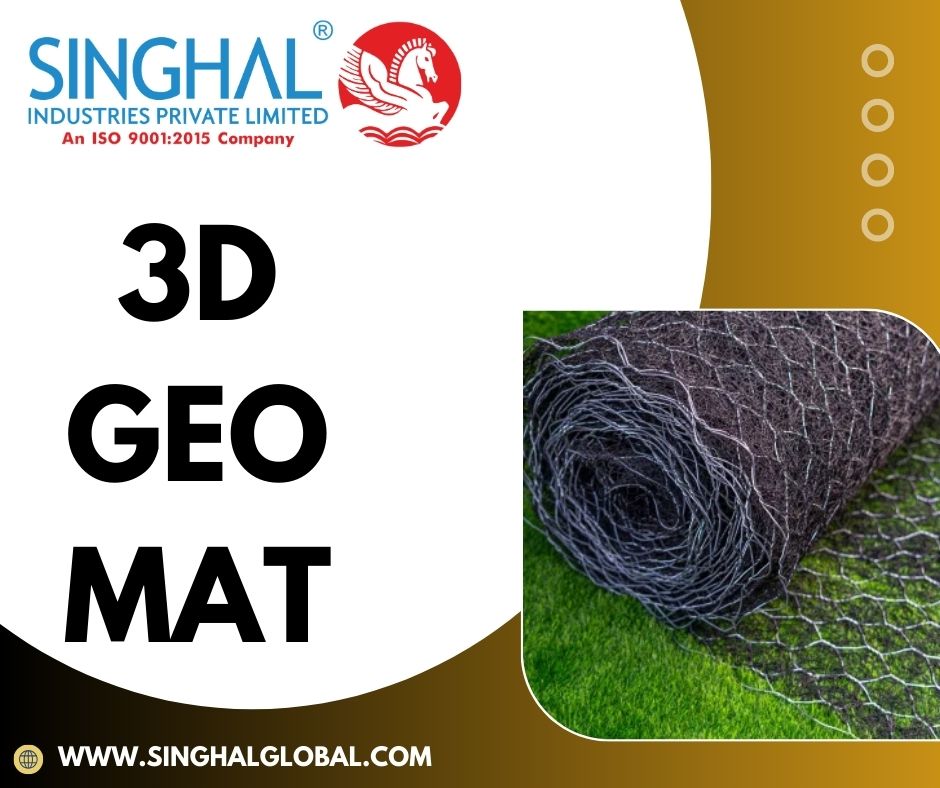
Three-dimensional geo-mats are complex, thick, interwoven, three-dimensional polymer mats usually consisting of polypropylene (PP) or high-density polyethylene (HDPE) and providing two very important functions at the same time: the immediate locking of soil and reinforcement by the growth of roots for many years. Unlike simple nets or meshes, the structure of 3D geo-mats provides a dense layer that holds all particles of the soil, seeds, and even stones. However, does the real secret lie in future functions of 3D geo-mats? Of course, yes – as the plants develop and grow through interwoven threads of a geo-mat, the roots interweave with the material, creating a natural reinforcement for the slope. Thus, it is possible to receive immediate protection against erosion along with the development of an ecological self-supporting reinforcement system. This makes 3D geo-mats one of the best solutions for ecological roads, rivers, dams, and hills.
Open, Porous Texture That Helps Easy Access of Seeds, Soil, and Water
One of the greatest qualities of 3D geo mats is its open, porous structure that ensures easy access of seeds, soil, and water rather than accumulation on the surface or being washed away. Entangled fibers form gaps and tunnels in which plant material can be accommodated and stimulate the rapid growth of healthy vegetation. Isn’t this very important for long-lasting stability? Of course—it means that without such a structure seeds would just be blowing away or drying out, and the slope would remain barren and unstable. This matrix keeps the moisture at the surface, decreases evaporation and protects sprouts from winds and rains. However, do all the plants grow through it? Almost all the ground cover plants grow through it, mostly grass and shrubs; while trees usually require more space or special anchorages. So we have a live slope that resists erosion naturally, as the vegetation does its work over time.
Instant Erosion Control From Rainstorms, Runoff and Wind Prior To Plant Growth
Unlike purely vegetative techniques which require several months to set in, 3D geo mats ensure immediate erosion control after installation. They offer protection from erosion caused by the first rainstorm, runoff or wind even before the plants start growing. Can you appreciate the significance of instant cover at newly built construction sites, embankments or for emergency repair? Sure! Without instant coverage, a single rainstorm can cause irreparable damage washing away all your efforts and causing drainage blockages. The mat will keep the soil in its position, reduce velocity of the surface and minimize the amount of sediment washed into the river, stream or storm drain. Do 3D geo mats prevent deep erosion? No, not completely – mats are suitable only for surface erosion control, while deeper problems may be solved using drains, anchors or retaining walls.
Flexible and Gap-Free Protection Against Inflexible Surfaces
Three-dimensional geo mats are very flexible and thus enable a tight fit over irregular, rugged or curved surfaces without any gaps, wrinkles or tearing. They roll effortlessly over rough spots, uneven areas, rocks, changes in angle of slope, always staying in contact with the surface beneath. Isn’t this flexibility crucial in real conditions? Definitely—rigid plates and inflexible grids often end up having some open spots through which water may come in and cause erosion. Geo mats bend and stretch somewhat to adapt to the shape while remaining undamaged. However, aren’t they prone to tear under a heavy load? No—if made of high-quality PP/HDPE; great tensile strength and tangled fibers will help avoid any splitting. It results in a fully covered protective barrier with no openings at all. This is what makes 3D geo mats perfect for application in various slopes, river curves, dam surfaces and hilly terrains.
Longevity: UV Resistant, Chemically Stable and 30 to 50 Years of Durability
The latest technology 3D geo mats are known for their durability due to UV stabilization, chemical stability, high tensile strength and will serve you for more than 30 to 50 years depending on the weather conditions. Such materials cannot corrode, decompose or deteriorate biologically in any way. They can withstand even such aggressive environmental factors as acid rains, salt water or industrial pollution. Isn’t it important for your infrastructural project? Yes – quick deterioration of material means additional expenses. But isn’t sunlight harmful to 3D mats? Only if it’s not UV resistant and only if it’s constantly exposed to the sun’s rays because once installed or covered with soil it won’t see light anymore and its life becomes much longer.
India Market: Ahmedabad Manufacturers, Mumbai Suppliers, and Reliable Brands
The Indian market for 3D geo mats is developing, influenced by the increasing need for highways, dam protection, river restoration, and greener construction projects. When looking for suppliers of 3D geo mats for such projects, look for a “3D geomat manufacturer Ahmedabad” or “3D geomat supplier Mumbai.” Manufacturers in Gujarat, particularly Ahmedabad, Kalol, and Vadodara, can supply customized products with respect to the required thickness, density, PP/HDPE type, UV stability, and bulk quantities; while suppliers from Mumbai can provide quick shipment of samples and other technical advice for use in Maharashtra projects. However, quality may vary significantly because there are thin, not very strong and non-UV-stable mats as well as thick, high-quality and UV-stable mats. Look for tensile strength, entanglement density, UV stability, and conformance to IS/ISO requirements. There is often technical assistance, advice and installation tips provided by the local team. The current trend involves more local manufacturers, higher standards, and application for highways, railways, dams, and ecological projects. For reliable sources, you can look at such reputable brands as Singhal Indutries Pvt Ltd (note: likely a typo) that specializes in geosynthetics and plastic materials used in civil engineering.
Installation Techniques: Surface Preparation, Tight Rolling, Fixing, and Vegetation
Proper installation is crucial for 3D geo mats operation. Edges and overlaps have to be pinned every 1–2 meters using stakes, pins, or anchor system. Also, the rolls need to be overlapped 150-300 mm. Finally, 50-100 mm of soil or seed mix should be spread for vegetative cover. Don’t you think that such step-by-step technique is very important? It is! Loose mats lift in wind or water; poor overlaps make weak spots. However, does it mean that you will need heavy equipment? No, small slopes can be installed manually with the help of gloves and stakes.
Conclusion
The use of 3D geo-mats will help strengthen the slope by securing the soil in all directions; it will be incorporated with the plants’ roots and provide storm protection, adapt to any terrain, and be durable for 30–50 years. 3D geo-mats will make your dangerous slopes safe and greener; it will require less maintenance and will look more appealing. While working on the project in India, try looking for a “3D geomat manufacturer Ahmedabad” or “3D geomat supplier Mumbai,” and you can choose Singhal Indutries Pvt Ltd (Singhal Industries Pvt Ltd).
Frequently Asked Questions:
Q1. What are the differences between 3D geomat and flat erosion mat?
The 3D geomat is made of deeply interconnected fibers that hold the soil firmly and prevent slipping, while the flat mats lie on the soil surface and slip easily on the slopes.
Q2. What is the thickness of a regular 3D geomat?
The standard thickness varies within 10 mm – 30 mm depending on the angle of the slope, soil characteristics and erosion risks.
Q3. Is it possible to use 3D geomats on very steep slopes?
Yes, with anchors, stakes, or vegetation. They are suitable for slopes up to 45-60 degrees, and sometimes even more.
Q4. Are 3D geomats recyclable after being used?
Yes, PP and HDPE geomats can be recycled after their use since many organizations recycle used mats to make new plastic products.
Q5. Who is the largest manufacture of 3D Geomat?
There isn’t any specific manufacturer of 3D Geomats that can be said to be the largest global manufacturer since this is a field that is not covered by any specific company but by different companies manufacturing geosynthetics in Asia, Europe, and North America. In India, there isn’t any specific company that is said to be the largest manufacturer of 3D Geomats.