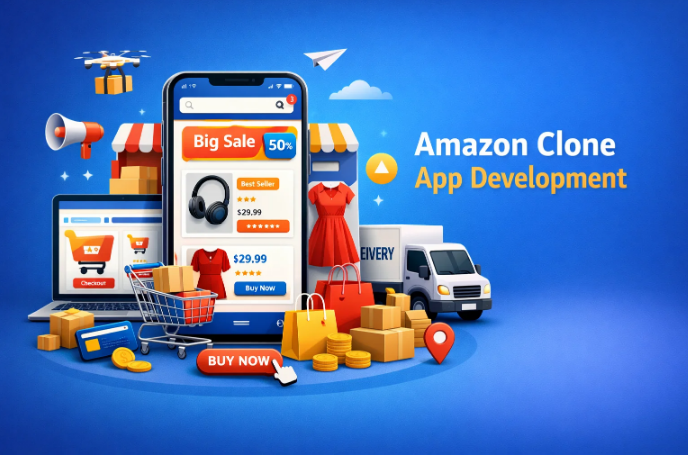
e evolving landscape of eCommerce, startups are constantly seeking ways to scale rapidly while minimizing overhead. One strategy gaining significant traction is the development of an Amazon clone. This approach allows businesses to create a robust, feature-rich marketplace that emulates the operational efficiency and user experience of Amazon. By leveraging modern technologies, a startup can quickly transform into a multi-vendor powerhouse capable of handling complex vendor ecosystems.
Understanding the Power of an Amazon Clone App
An Amazon clone app is more than just a replica of the popular eCommerce platform; it is a customizable framework that enables startups to manage multiple vendors, products, and customer interactions efficiently. These apps typically include essential functionalities such as real-time inventory tracking, payment gateway integrations, vendor dashboards, and AI-powered recommendation engines. For technology-driven startups, building an Amazon-like app provides a head start, bypassing years of trial-and-error in marketplace design.
By adopting an Amazon clone, businesses can focus on scaling vendor networks instead of starting from scratch. Vendors gain autonomy in managing their stores, while customers enjoy seamless navigation, search, and checkout experiences. The technical backbone of these apps ensures that growth in product listings or users does not compromise performance, which is critical for startups aiming to expand quickly.
Building a Multi-Vendor Marketplace in Days
One of the most significant advantages of modern Amazon clone apps is speed to market. Startups can deploy a fully functional multi-vendor marketplace in days, rather than months, thanks to modular development frameworks and prebuilt architectures. Backend frameworks such as Node.js, Django, or Laravel, paired with robust frontend technologies like React or Flutter, allow startups to integrate complex features quickly without compromising performance or security.
Cloud-based architectures and microservices further support scalability. Each vendor operates almost like an independent microservice within the ecosystem, meaning updates, transactions, and analytics run concurrently without creating bottlenecks. This approach reduces the time needed to test, deploy, and iterate, allowing startups to focus on onboarding vendors and acquiring customers.
AI-Driven Features in an Amazon-Like App
Artificial intelligence is a game-changer for modern marketplaces. An AI-powered app can offer personalized recommendations, predictive analytics, demand forecasting, and intelligent search capabilities. For startups, this means that vendors can reach target audiences more effectively, while users enjoy a tailored shopping experience.
Machine learning algorithms embedded in Amazon clone apps analyze user behavior and preferences, suggesting products that align with purchase patterns. AI also supports dynamic pricing, fraud detection, and inventory optimization, which are crucial for running a competitive multi-vendor marketplace.
Additionally, AI chatbots and virtual assistants can reduce the operational workload by handling customer queries, tracking orders, and offering real-time solutions. This integration ensures that even with hundreds of vendors and thousands of products, customer experience remains seamless and highly personalized.
Launching Your eCommerce Platform Without Delays
The process of creating an Amazon clone app involves careful planning, but modern development practices streamline it significantly. On-demand app development companies specialize in delivering scalable marketplaces with prebuilt templates and custom integrations. Startups can thus launch an eCommerce app without waiting for lengthy development cycles, focusing instead on market penetration and vendor acquisition.
These companies often provide cloud deployment, API integrations, and security audits, which are essential for multi-vendor platforms handling sensitive data. By adopting a ready-made framework, startups save on infrastructure costs while retaining flexibility for future enhancements.
Moreover, the use of DevOps pipelines in modern Amazon clone apps ensures faster deployment cycles and automated testing. This allows updates, patches, and new features to be integrated without downtime, maintaining smooth operations across multiple vendors.
Technical Architecture of a Multi-Vendor Amazon Clone
The strength of a multi-vendor Amazon clone lies in its architecture. Typically, it consists of:
- Front-end layer: Built using frameworks like React, Angular, or Flutter to ensure responsive interfaces for web and mobile.
- Backend services: Microservices architecture powered by Node.js, Django, or Laravel for modular development.
- Database management: Scalable solutions like PostgreSQL, MongoDB, or MySQL handle vendor inventories and user data efficiently.
- AI & Analytics: Machine learning modules for recommendation systems, predictive analytics, and business intelligence.
- Payment & Security: Secure gateways, tokenization, and encryption protocols ensure safe transactions across multiple vendors.
This technical foundation allows startups to accommodate hundreds of vendors, millions of products, and thousands of concurrent users without performance issues. Using containerization with Docker and orchestration through Kubernetes further enhances scalability and fault tolerance, making the platform robust against sudden traffic surges.
Benefits for Startups in Choosing an Amazon Clone App
For startups, leveraging an Amazon clone app offers multiple advantages. First, it accelerates market entry by reducing development time and cost. Second, it provides a proven marketplace model with vendor and customer management built-in. Third, its modular architecture allows startups to customize features according to niche markets or specific business models.
Moreover, the combination of AI, analytics, and automated workflows in these apps ensures operational efficiency, enabling startups to focus on scaling rather than troubleshooting. By implementing these technologies, even small teams can manage complex vendor ecosystems with minimal friction.
Additionally, integrating multi-channel capabilities, such as social commerce or mobile-first interfaces, enhances reach. Vendors can leverage analytics dashboards to track sales trends and optimize inventory, while startups can monitor the overall performance of the platform in real time.
Overcoming Challenges with Technology
Building a multi-vendor marketplace involves inherent challenges such as inventory synchronization, vendor management, fraud detection, and real-time order processing. However, modern Amazon clone apps overcome these through smart architecture and automation.
AI and machine learning algorithms automatically detect suspicious activity, optimize inventory levels, and forecast demand. Cloud computing and serverless technologies provide elasticity during traffic spikes. Additionally, API-driven architectures ensure that third-party integrations, such as logistics or payment providers, are seamless and maintain performance standards.
Scalable architecture also allows seamless global expansion. For startups, this means that vendors in different regions can operate under the same platform without causing latency or data inconsistency issues. Automated notifications, multi-currency support, and compliance with local regulations further streamline global operations.
Integrating Emerging Technologies
The next generation of Amazon-like apps is integrating cutting-edge technologies to stay competitive. Augmented Reality (AR) can provide customers with virtual try-ons, improving conversion rates for fashion and home decor products. Blockchain ensures secure and transparent transactions, especially for high-value items or cross-border sales.
IoT (Internet of Things) is also playing a role in inventory management and smart logistics. Connected devices can monitor stock levels in real-time and automatically trigger reorders. These integrations not only improve efficiency but also give startups a technology edge over competitors.
Monetization Strategies for Multi-Vendor Marketplaces
A well-structured Amazon clone enables multiple revenue streams. Commission-based models allow startups to earn a percentage of each vendor transaction. Subscription plans or premium services can offer advanced analytics or advertising tools to vendors. AI-powered upselling and cross-selling features can increase average order values, while dynamic pricing algorithms ensure competitiveness in the marketplace.
Additionally, integrating affiliate marketing, loyalty programs, or flash sales within the Amazon-like app can further drive engagement and revenue growth. Technology-driven insights help startups fine-tune these strategies and measure ROI effectively.
Future Trends in Multi-Vendor Amazon-Like Apps
As eCommerce evolves, multi-vendor marketplaces will increasingly rely on AI, AR/VR, and blockchain technologies. Features like AI-assisted customer support, AR-based product visualization, and blockchain-driven supply chain tracking are becoming standard. Startups that adopt these innovations in their Amazon clone app can offer differentiated experiences, improving vendor retention and customer loyalty.
Predictive analytics and AI-driven personalization will enable hyper-targeted marketing and dynamic inventory management, making it easier for startups to compete with established players. Cloud-native architectures will further allow on-demand scalability, supporting sudden growth in traffic or vendor onboarding without system downtime.
Conclusion
Adopting an Amazon clone is not merely a shortcut to launching an online marketplace—it is a strategic technological decision that can transform a startup into a multi-vendor powerhouse. By leveraging AI, modular development, cloud computing, and scalable architectures, businesses can deploy a multi-vendor marketplace in days, manage multiple vendors efficiently, and provide superior user experiences.
For startups aiming to make a mark in the competitive eCommerce space, investing in an Amazon-like app represents a smart, future-ready approach. With rapid deployment, AI-driven insights, and robust technical foundations, an Amazon clone app provides the tools necessary to scale, compete, and innovate at an unprecedented pace. By focusing on technological optimization rather than manual processes, startups can efficiently manage complex ecosystems, delight vendors and customers alike, and emerge as leaders in the online marketplace arena.